If you’ve been searching for arabic flashcards for kids, you’ve probably already found a hundred paid decks on Etsy and Amazon. Cute ones too. But here’s the thing — you don’t need to spend a dime. A handful of index cards, a marker, and twenty minutes is all it takes to make something your kid will actually use.
I’ve made flashcards for my own students more times than I can count. Some were fancy. Most were not. And honestly, the plain, slightly wonky homemade ones usually worked better than the polished ones I bought. Kids don’t care if the letter ع is perfectly centered. They care whether the game is fun.
So let’s get into it — letters, words, numbers, and how to actually use these things so they stick.
Why Flashcards Actually Work for Arabic
Arabic looks intimidating to a lot of parents before it ever gets to the kid. New alphabet, new direction, letters that change shape depending on where they sit in a word. That’s a lot.
Flashcards break all of that into bite-sized pieces. One letter. One word. One number. No pressure to read a whole sentence. Just recognize this one thing, say it, move on. That’s how kids build confidence — small wins, repeated a lot.
And there’s a bonus nobody talks about enough: flashcards are portable. Waiting room, car ride, five minutes before dinner. You don’t need a lesson plan. You just need the cards.
Letter Flashcards: Where to Start
Start with the alphabet, obviously, but don’t try to cram all 28 letters onto the table at once. That’s how kids shut down.
A few ways I’ve done it with students:
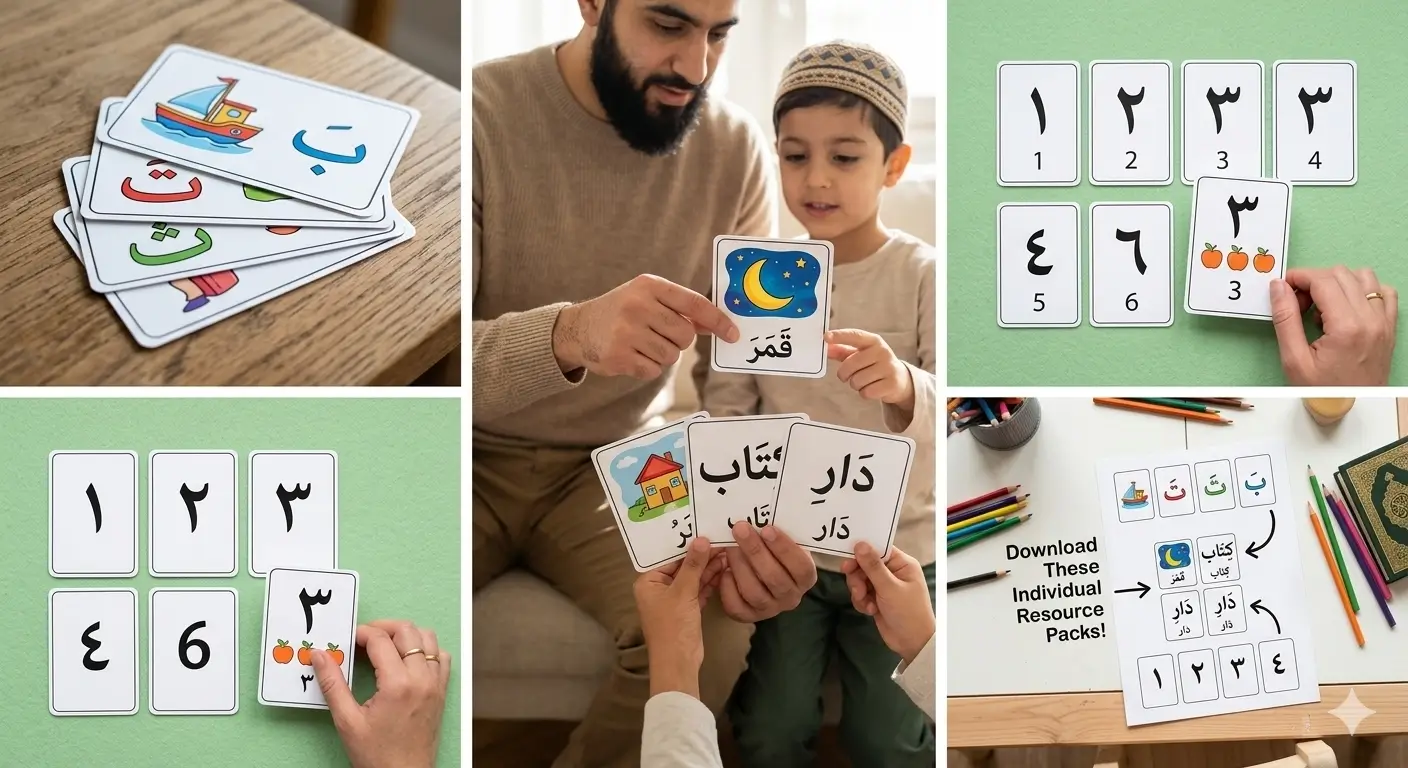
- One letter per card, big and bold. Write the letter in its isolated form first. Don’t worry about initial, medial, and final forms yet — that comes later, once the letter itself is familiar.
- Color code by sound family. Group letters that sound similar (like س and ص, or د and ض) in the same color. It helps kids notice the difference instead of lumping them together.
- Add a simple picture clue. A ب card with a little drawing of a door (باب) gives the brain something to hook the sound to. You don’t need to be an artist — stick figures are fine.
I’ll be straight with you: don’t introduce more than 3-4 new letters a week with young kids. It feels slow. It’s not. Slow and steady is what actually sticks.
Word Flashcards: Moving Past the Alphabet
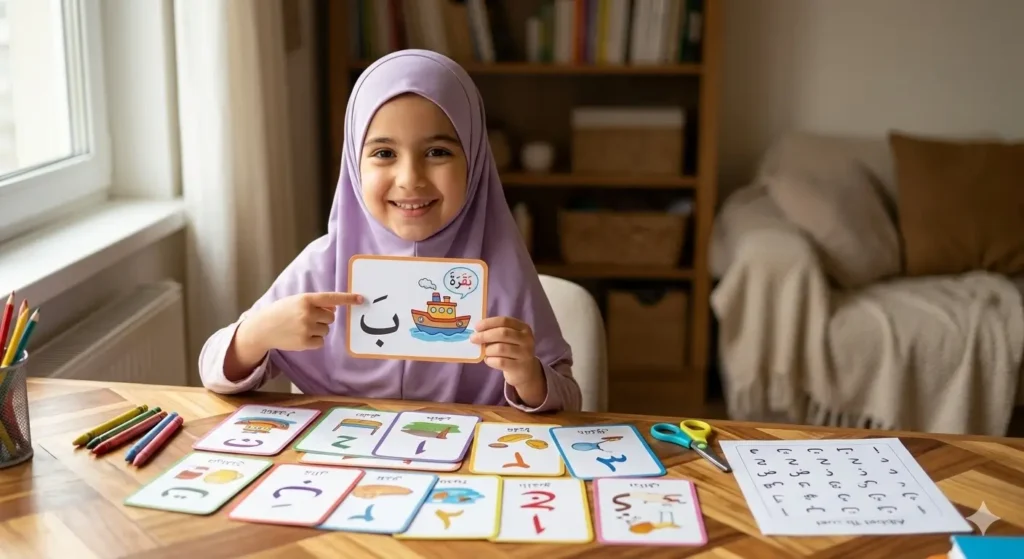
Once your child knows a chunk of letters, word cards keep things moving without making the jump to full sentences too soon.
Best categories to start with:
- Family words — أم، أب، أخ، أخت
- Animals — قطة، كلب، أسد
- Food — تفاح، خبز، ماء
- Everyday objects — كتاب، قلم، باب
Put the Arabic word on one side and a picture (not the English translation) on the other. This matters more than it sounds like it should. If you always pair Arabic with English, the brain starts translating instead of just knowing. Picture pairing skips that step entirely.
If your child is also working through colors, this pairs nicely with a colors-focused practice set — same idea, just swap in color words and matching swatches instead of pictures.
Number Flashcards: Keep It Playful
Numbers are honestly some of the easiest flashcards to make fun, because you can turn them into games so easily.
- Write the numeral on one side, the Arabic word on the other (١ / واحد, ٢ / اثنان, and so on)
- Use dot patterns like dice — one dot, two dots — so kids can count instead of just memorizing shapes
- Mix in real objects: “Bring me ثلاثة spoons”
Numbers 1-10 is plenty to start. Don’t rush to 20. A kid who’s solid on 1-10 will pick up the teens fast later. A kid who’s shaky on 1-10 will just get confused no matter how far you push.
How to Make Your Own Printable Set at Home
You genuinely don’t need fancy software for this.
- Index cards or cardstock. Cut regular paper in half if that’s what you’ve got. It doesn’t need to be pretty.
- A simple template. Even a basic table in Word or Google Docs works — one cell per card, print, cut.
- Laminate if you can. A cheap laminator (or even packing tape) means the cards survive sticky toddler hands and get reused for months.
- Keep a “mastered” pile separate from the “still learning” pile. This alone makes review sessions way faster, because you’re not re-testing letters your kid already knows cold.
If printing isn’t your thing, plain handwritten cards work just as well. The learning doesn’t come from the printer — it comes from the repetition.
Simple Games to Use With the Cards
Flashcards get boring fast if all you do is flip through them and say the word. Here’s what actually holds a kid’s attention:
- Memory match — flip cards face down, find the pairs
- Speed sort — time how fast they can put the letters in order
- Hide and seek — hide cards around the room, kid finds them and says the sound out loud
- Toss and say — lay cards on the floor, kid tosses a soft ball onto one and has to name it
None of these need special materials. They just need the cards you already made.
A Quick Note on Consistency
Here’s what nobody tells new parents starting this journey: the cards themselves matter less than showing up with them regularly. Ten minutes a day beats one long hour on a Sunday. Kids forget fast if there’s a week-long gap, and that’s not a reflection of whether the flashcards were “good” — it’s just how memory works at that age.
If your child is also getting started with the alphabet itself, it’s worth pairing this with a proper walkthrough of the Arabic letters, so the flashcards reinforce what they’re already learning rather than introducing everything all at once.
Final Thoughts
You don’t need to buy a set of arabic flashcards for kids to get this started tonight. Grab some paper, pick five letters or five words, and go. The fancy version can come later — the habit is what actually builds fluency.