Let me guess how you got here.
Your child speaks some Arabic. Maybe they get it from grandparents, or Quran classes, or a few years of weekend school. Someone said, “Why not do the GCSE?” And now you’ve got a hundred questions and no clear answer.
Fair enough. Arabic GCSE isn’t like Maths or English, where every school has a department and a pile of past papers. It’s a smaller subject. Information is scattered. So here’s the full picture, in one place.
What is Arabic GCSE?
It’s a GCSE in Arabic language, graded 9 to 1 like every other GCSE. Pearson Edexcel is the board that runs it (the specification code is 1AA0). It tests four skills: listening, speaking, reading and writing.
Quick note before we go on. Edexcel also runs an International GCSE in Arabic, which is a different qualification with a different structure. This article covers the regular GCSE only. Always check your child’s exact entry with their school or exam centre.
How many kids take it? Not as many as you’d think. In summer 2025, around 5,300 students sat Arabic GCSE across the UK, and about 1,550 of them got a grade 9. That’s nearly three in ten.
Now, don’t read that as “it’s easy.” It’s a small group, and many of those students already speak Arabic at home or study it seriously. A high top-grade rate tells you the strong kids do very well. It doesn’t tell you the exam is a walk in the park.
Here’s the thing about “my child already speaks Arabic”
I’ll be straight with you, because this is the single biggest misunderstanding I see.
Speaking Arabic at home and passing Arabic GCSE are two different skills.
Most kids who grow up with Arabic speak a dialect. Egyptian, Levantine, Gulf, Moroccan, whatever the family uses. The exam doesn’t test your child’s dialect. The listening paper uses standard spoken Arabic. The reading and writing papers use standard written Arabic.
That’s close to what we call Modern Standard Arabic, or fusha. It’s the Arabic of news, books and formal writing. It has its own vocabulary, its own grammar patterns, its own rules for spelling.
So you can have a kid who chats happily with grandma and still freezes at a reading passage. Or one who can’t write a proper paragraph. It happens all the time. It isn’t a sign your child is “bad at Arabic.” It’s just that nobody ever taught them the written, formal side.
If your child mostly uses a spoken dialect, that’s a great head start for speaking confidence. It just isn’t the whole job. (Curious about how dialect learning works for children? Our Egyptian Arabic for kids page explains our approach.)
The four papers, in plain English
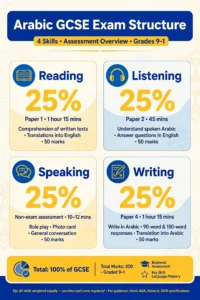
Every skill is worth 25% of the final grade. Your child takes the same tier across all four papers. No mixing Foundation listening with Higher writing.
Here’s the layout. The timings below come from published guidance on the current spec, so confirm them against the official Pearson documents for your child’s exam year.
| Paper | Skill | Foundation | Higher |
|---|---|---|---|
| 1 | Listening | 35 mins (incl. 5 mins reading time) | 45 mins (incl. 5 mins reading time) |
| 2 | Speaking | 7–9 mins, plus 12 mins prep | 10–12 mins, plus 12 mins prep |
| 3 | Reading | 50 mins | 1 hr 5 mins |
| 4 | Writing | 1 hr 15 mins | 1 hr 25 mins |
Listening. Recordings with male and female speakers. Each one is played twice. Some questions are in English, some in Arabic. Kids who use the reading time properly do noticeably better.
Speaking. This one is a surprise to many parents. It’s not a free chat. There are three tasks in a fixed order: a role play, a picture-based task, and a conversation. There’s 12 minutes of preparation first. A teacher at the exam centre runs it, and Pearson marks it externally.
Reading. Adverts, emails, articles, that kind of thing. There’s a translation from Arabic into English at the end, and every question has to be answered.
Writing. All the instructions are in Arabic. Kids write short and longer responses, and there’s a translation from English into Arabic. Each bullet point in the question has to be covered.
And one rule that catches families out: no dictionaries. Not in any paper. Not even during the speaking prep time. So practising with a dictionary on the desk gives a false picture of how ready your child is.
Foundation or Higher?
Same topics, different demands.
Foundation covers grades 1 to 5. Higher covers grades 4 to 9. The papers on Higher are longer and expect more complex language, more opinions, and more independence.
So which one? Honestly, it depends on the child, and the decision is normally made with the teacher or tutor once there’s real evidence. Past paper scores. Writing samples. How they handle a speaking task cold.
Don’t pick a tier out of pride. And don’t pick it out of fear either. A confident grade 5 on Foundation can beat a shaky Higher attempt that scrapes a 4. The right tier is the one where your child can show what they actually know, consistently.
What’s actually on the exam: the five themes
Everything is built around five themes:
- Identity and culture
- Local area, holiday and travel
- School
- Future aspirations, study and work
- International and global dimension
The themes are studied in the context of the child’s home country and Arabic-speaking countries and communities. So expect questions about daily life, hobbies, family, school subjects, holidays, jobs, the environment, and so on.
Here’s a point that matters more than the topic list. Questions often ask for present, past and future in the same answer. “Tell me what you do, what you did last summer, and what you plan to do next year.” Kids who only manage the present tense lose marks fast.
Where kids lose marks (straight from the examiner reports)
Pearson publishes principal examiner feedback each year. It’s worth a read. A few patterns from recent reports:
- Time frames. In writing, many candidates struggled with using present, past and future correctly, especially the future for plans.
- Wandering off task. Some students drifted into a different topic, like fitness or diet, instead of answering the question they were given.
- Similar-looking vocabulary. Examiners flagged confusion between related terms, like global warming and climate change, and some students invented odd literal translations instead of using the right Arabic words.
- Basic vocabulary gaps in listening. Colours, time expressions, adjectives and the names of Arabic-speaking countries tripped some candidates up.
- Speaking format. Speaking performance dropped when students didn’t follow the task structure.
Notice what’s missing from that list? Nothing about advanced literature or obscure grammar. These are fixable, practical issues. Which is good news.
When should your child start preparing?
I don’t love giving one-size-fits-all answers, but here’s my honest take.
Most students sit the exam in Year 11, and the speaking assessment happens in the spring, with the other papers in May and June. If your child already reads and writes Arabic with reasonable confidence, a focused year of exam preparation can be enough. If they can speak but barely read or write, give it longer. Eighteen months to two years is a much safer runway, because writing in standard Arabic takes real time to build.
And if your child is still learning the alphabet? Don’t panic, and don’t rush. Start with solid foundations. Our Arabic for beginners course is built for exactly that, and you can move into exam preparation once reading and basic writing are steady.
If you’re not sure where your child sits, a short assessment will tell you far more than guessing. That’s what the free trial is for.
How to prepare for Arabic GCSE (what actually works)
Skip the vocabulary-list-only approach. Vocabulary matters, but knowing words isn’t the same as performing in an exam. Practise each paper the way it’s tested.
Listening: Do timed extracts. Then check the mistakes. Was it a missed word? A distractor? A speaker who changed their mind halfway through? Learn to listen for corrections and contrasts.
Speaking: Practise short, unscripted answers. Record them. Then ask unexpected follow-up questions. A memorised speech falls apart the moment the examiner asks something slightly different. Kids need flexible sentences, not a script.
Reading: Read the question first, then the passage. And practise both English-language and Arabic-language question styles, plus translation. Kids get thrown when the instructions themselves are in Arabic.
Writing: One timed piece a week works well. Before writing, tick off each bullet point and decide where the past, present and future will go. Then check agreement, verb forms and spelling. Rewrite the weakest paragraph. That rewrite is where the learning happens.
Past papers: Use them, but use them well. A score tells you what happened. A correction changes what happens next. After every paper, write down exactly why each mark was lost, then fix that specific thing.
And do all of it without a dictionary. Better to find the gaps in October than in June.
Can you do Arabic GCSE online?
Yes. And for many families it’s the more realistic option.
Most schools in the UK don’t offer Arabic as a GCSE option. So families look for evening classes, weekend schools or private tutors. Online lessons remove the travel, give you a wider choice of experienced teachers, and let you build lessons around the child’s weak papers instead of a fixed class timetable.
But “online Arabic” is a broad label. When you’re comparing options, ask these questions:
- Do they teach to the Edexcel specification, or just “general Arabic”?
- Do they cover all four skills, including speaking practice with feedback?
- Is there regular writing practice with proper correction?
- Do they use timed past-paper style tasks and mock tests?
- Do they teach standard Arabic, not just dialect?
Our Arabic GCSE / Curriculum Studies course is built around exactly this: exam preparation, vocabulary and writing structure, reading comprehension and essays, plus mock tests and exam tips. It’s designed for students aged 12 to 17.
And if your child is already a strong reader who wants to go beyond the exam, our Advanced Arabic for kids programme is a natural next step. Strong GCSE preparation and strong general Arabic feed each other, so it’s not either/or.
The practical bits parents ask about
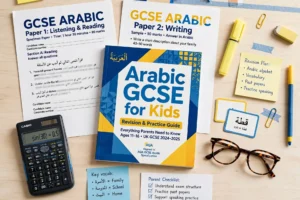
Where does my child sit the exam? Usually at their own school, if the school enters students for Arabic. If not, you’ll need an exam centre that accepts external candidates. These centres have entry deadlines well before the summer, and the speaking assessment has to be arranged by the centre, so ask early. If your child is aiming for summer 2027, now is the time to start those conversations.
Does a GCSE in Arabic actually help? It’s a real, internationally recognised qualification in a language that’s valuable for careers, university applications and family connection. I’m not going to pretend it will transform an application on its own. But it shows serious commitment to a language most students never study formally. And for heritage families, it turns something your child already half-owns into something proven.
Can my child do both Quran studies and GCSE Arabic? Absolutely, and they often support each other. Reading fluency from Qur’anic Arabic helps with decoding and pronunciation. Just remember the exam itself tests modern standard Arabic across everyday themes, so the vocabulary needs separate attention.
What if my child is a grade 3 or 4 level right now? That’s a workable starting point if there’s time. Progress usually comes fastest from writing practice and vocabulary tied to the five themes, not from more of the same general conversation.
A simple plan for the next 30 days
You don’t need to overhaul everything. Try this:
- Week 1: Find out the exam board and tier. Download the specification and one past paper from Pearson’s site.
- Week 2: Have your child try a reading section and a short writing task, with no dictionary and with a timer. Don’t mark harshly. Just observe.
- Week 3: Identify the weakest of the four skills. It’s usually writing or listening for heritage speakers.
- Week 4: Get a proper assessment from a teacher who knows the spec, and build a timeline back from the exam date.
That’s it. No panic. Just information.
Ready to see where your child stands?
Arabic GCSE rewards steady, targeted preparation far more than last-minute cramming. The kids who do best usually have three things: a teacher who knows the exam, regular writing and speaking practice, and parents who start early.
If you’d like to find out where your child is right now, book a free trial class. We’ll assess their reading, writing and speaking, and tell you honestly what the path to GCSE looks like. No pressure and no hard sell.
Want to explore the bigger picture first? Start with our complete guide to learning Arabic for kids, or browse more guides on the Arabic for Kids blog.