Let’s be honest for a second. If you’ve ever tried to sit your kid down for a “structured Arabic lesson,” you already know how that goes. Five minutes in, they’re staring at the ceiling. Ten minutes in, they’re asking for a snack. And by minute fifteen, you’re the one who needs a break.
Here’s the thing — cartoons work when lessons don’t. Not because they’re easier. Because your kid isn’t thinking “I’m learning a language” while they watch. They’re just watching. The Arabic sneaks in sideways, through a story they actually care about.
I’ve spent years watching parents try this, and I’ve watched which channels actually stick and which ones get abandoned after one episode. This list is the stuff that works. No fluff, no “50 channels you’ll never actually check,” just the ones worth your kid’s screen time.
Why YouTube (and Not a DVD or an App)
I’ll be straight with you — YouTube isn’t perfect. It’s not curated. Anything can show up next in the sidebar if you’re not careful. But it beats the alternatives for three reasons:
- It’s free. You’re not buying a subscription just to test whether your kid likes Arabic cartoons.
- It’s endless. One good channel leads to a hundred related videos. Kids binge. That’s fine here — repetition is actually how vocabulary sticks.
- You can control it. Use YouTube Kids, turn off autoplay, or just sit with them the first few times. It takes five minutes to set up and it’s worth it.
And one more thing nobody tells you: dialect matters. Some of these channels use Modern Standard Arabic (MSA) — the “textbook” Arabic used in schools, news, and books. Others use Egyptian or Gulf dialect, which is what people actually speak at home. Neither is wrong. But know which one you’re getting, because they sound pretty different to a beginner’s ear.
The Best Arabic Cartoons and Channels for Kids
1. Iftah Ya Simsim (افتح يا سمسم)
This is the Arabic-language Sesame Street, originally produced for Gulf audiences and now archived in full on YouTube. If your child already knows Sesame Street in English, this is the easiest entry point you’ll find — familiar format, familiar pacing, just in Arabic. It uses fairly clear MSA, which makes it a solid pick if your goal is the “school Arabic” your child will eventually read and write.
Best for: Ages 3-7, total beginners, parents who want MSA foundations early.
2. Mansour (كرتون منصور)
A hugely popular animated series out of Saudi Arabia. Mansour is a young boy having everyday adventures, and honestly, the storytelling holds up — kids watch this because they like the character, not because a parent made them. The Arabic used leans toward simplified MSA with some dialect mixed in depending on the episode.
Best for: Ages 4-9, kids who need a character to actually care about.
3. Toyor Al Janah (طيور الجنة)
This one’s a bit different — it’s mostly songs. Nasheeds and kids’ songs, heavy on repetition, bright animation, simple vocabulary. If your child learns better through music (a lot of them do), this channel is basically built for that. You’ll hear numbers, colors, animals, and family words on loop, which is exactly the kind of repetition that makes new words stick.
Best for: Ages 2-6, kids who respond to music more than dialogue.
4. Baraem TV Content
Baraem was a dedicated Arabic kids’ TV channel, and a lot of its content — songs, short educational segments, simple stories — now lives on YouTube. It’s not flashy. But it’s clean, age-appropriate, and consistently produced with young Arabic learners in mind rather than just entertainment first.
Best for: Ages 3-8, parents who want low-stimulation, calmer content.
5. Arabic-Dubbed Versions of Familiar Kids’ Shows
Here’s a trick a lot of parents miss. Several well-known international children’s shows have official Arabic-dubbed versions on YouTube. If your kid already loves a specific show in English, search for its Arabic dub before assuming you need to start from zero with unfamiliar characters. Recognition does half the work — they already know the plot, so their brain is free to focus on the language instead of figuring out the story.
Best for: Any age, especially kids who are picky about new shows.
6. Alphabet and Phonics Channels
Separate from story-based cartoons, there’s a whole category of Arabic alphabet channels — songs built around the 28 letters, tracing videos, “letter of the day” style content. These aren’t as entertaining, but they pair well with everything above. Watch a story cartoon for fun, watch a letter song for the actual mechanics of reading.
Best for: Ages 3-6, right around when kids start recognizing letters in any language.
What Your Kid Actually Picks Up From These
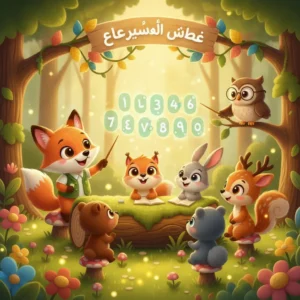
Parents ask me this constantly: “Is watching cartoons actually teaching them anything, or is it just noise?” Fair question. Here’s what tends to happen with regular exposure.
Vocabulary comes first, and it comes in categories. Numbers show up constantly — counting characters, counting objects, birthday episodes. If you want to reinforce that at home instead of just hoping it sinks in passively, our numbers guide breaks down exactly how Arabic numbers are built, which makes the cartoon repetition click faster.
Colors are everywhere too — clothing, backgrounds, describing objects. Arabic colors change form depending on whether they’re describing something masculine or feminine, which is a detail most cartoons don’t explain (why would they, they’re cartoons). If your child starts saying colors but you want to help them actually use them correctly in sentences, this guide to color and adjective agreement fills that gap.
Sentence rhythm sinks in without anyone teaching it directly. Questions, greetings, simple commands — kids absorb the shape of these before they can explain any grammar rule. That’s normal. That’s actually how first-language acquisition works too.
If you’re starting completely from scratch and want a full roadmap — not just cartoons, but an actual path from zero to speaking — our Arabic for beginners guide lays out the whole thing step by step.
How to Actually Use These Cartoons (Not Just Play Them)
Putting a cartoon on and walking away isn’t nothing. It helps. But if you’ve got even ten extra minutes, a few small habits make a real difference.
- Watch the first episode with them once. You don’t need to understand Arabic yourself. Just notice what they react to — a character, a song, a specific scene — so you know what to lean into later.
- Repeat episodes on purpose. I know it feels like your kid should be moving on to new content constantly. They shouldn’t. Repetition is where the actual learning happens. The tenth viewing teaches more than the first.
- Pause and point. “What color is that?” “How many are there?” Doesn’t need to be formal. Thirty seconds here and there adds up over weeks.
- Don’t correct pronunciation harshly. If they mimic a word wrong, just say it back correctly in a normal sentence. Kids pick up correction through modeling far better than through being told “no, that’s wrong.”
- Mix cartoons with real interaction. Cartoons are input. They’re not enough on their own for a kid to actually start speaking confidently — that part needs a real person responding to what they say, adjusting, encouraging. That’s the piece a screen genuinely can’t replace.
Common Mistakes Parents Make With This
I’ve seen the same few mistakes over and over, so let me save you the trouble.
Switching channels too often. New content feels productive. It’s usually the opposite — kids need the same words repeated across multiple episodes before those words actually become theirs.
Expecting cartoons alone to build speaking skills. They build listening comprehension and vocabulary recognition really well. Speaking is a different skill, and it needs a different kind of practice — actual back-and-forth conversation.
Ignoring dialect mismatch. If your family speaks Egyptian Arabic at home but the cartoons are all Gulf dialect (or vice versa), your child might learn words that sound slightly foreign to what they hear from you. Not a disaster, but worth knowing so you’re not confused later when the words don’t quite match.
Treating it as a babysitter instead of a tool. Even fifteen minutes of a parent occasionally engaging — asking a question, repeating a word, laughing at the same joke — turns passive watching into something that actually sticks.
A Quick Word on Screen Time
I’m not going to pretend unlimited cartoon time is the goal here. It’s not. Twenty to thirty minutes a day of Arabic content, watched somewhat intentionally, will do more for your child’s Arabic than two hours of passive background noise. Quality of attention matters more than quantity of minutes. That’s true for adults learning a language too, honestly.
Where Cartoons Can’t Take Your Child
Cartoons are a genuinely great starting point. They build an ear for the language, a base of vocabulary, and — maybe most importantly — a positive feeling about Arabic instead of a “this is homework” feeling. That emotional part matters more than people give it credit for.
But at some point, your child needs a real person to talk back. Someone who notices when they’re close to a word and helps them finish it. Someone who adjusts a lesson because today they’re tired, or excited, or stuck on one specific sound. A cartoon can’t do that. A patient, native-speaking teacher can.
If you’ve got a child watching Arabic cartoons already and you’re wondering what the next step looks like, that’s exactly where we come in. Our kids’ program builds directly on what cartoons start — real conversation, structured but playful lessons, and teachers who know how to keep a five-year-old actually engaged for a full session.
Book a Free Trial and see how it fits with what your child’s already watching and loving.