Arabic Colors for Kids: A Simple Vocabulary Guide

Teaching your kid colors in Arabic is one of those “small win, big payoff” moments. It’s not overwhelming. It’s not grammar-heavy. It’s just words your child can point at, say out loud, and actually use — today, in the same afternoon you teach them.
Here’s the thing though: most color lists online just throw eleven Arabic words at you and call it a day. That’s not how kids learn. They learn by touching, pointing, repeating, and laughing when they get it wrong. So this guide isn’t just a list. It’s a list plus a plan.
Let’s get into it.
Why Start With Colors?
Colors are one of the first vocabulary sets we teach at Alphabet Arabic Academy, and honestly, there’s a reason for that. Colors are:
- Everywhere. Your child doesn’t need a classroom. The red car, the blue cup, the green tree outside — it’s all a lesson.
- Visual. No abstract concepts. A color either matches or it doesn’t. Kids get instant feedback.
- Short. Most Arabic color words are one or two syllables once you break them down. Easy wins build confidence fast.
And confidence is really the whole game with young learners. A kid who feels like they’re “good at Arabic” after week one will keep going. A kid who feels lost won’t.
The Basic Arabic Colors (With Pronunciation)
Here’s your core list. I’ve kept the pronunciation guide simple — no linguistics degree needed.
| Color | Arabic | Pronunciation |
|---|---|---|
| Red | أحمر | AH-mar |
| Blue | أزرق | AZ-raq |
| Green | أخضر | AKH-dar |
| Yellow | أصفر | AS-far |
| Black | أسود | AS-wad |
| White | أبيض | AB-yad |
| Pink | وردي | WAR-dee |
| Purple | بنفسجي | ba-NAF-sa-jee |
| Orange | برتقالي | bur-tu-QAA-lee |
| Brown | بني | BUN-nee |
| Gray | رمادي | ra-MAA-dee |
A quick note before you dive in: Arabic colors change form depending on whether they’re describing a masculine or feminine noun. “Red car” (masculine) is سيارة حمراء — wait, actually, “car” (سيارة) is feminine in Arabic, so it’s hamra, not ahmar. I know, I know. It sounds confusing the moment you write it down.
Honestly? Don’t worry about this yet. Not with young kids. Teach the base form first — أحمر, أزرق, أخضر — and let the masculine/feminine stuff come later, once your child is comfortable with the words themselves. Piling grammar on top of a five-year-old learning their first fifteen words in a new language is a fast way to make them hate the lesson.
How to Actually Teach These (Not Just List Them)
I’ll be straight with you — flashcards alone don’t work for most kids past the first five minutes. You need movement, repetition, and a bit of silliness. Here’s what actually sticks.
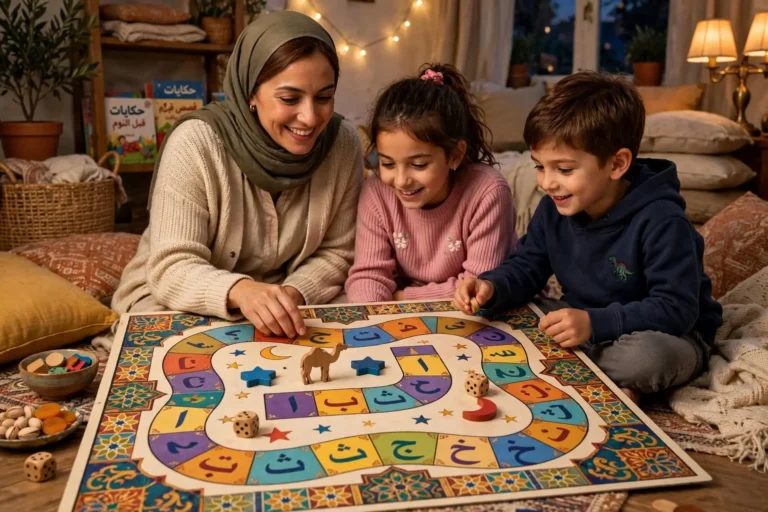
1. The Color Hunt
Pick one color. Say the Arabic word. Then send your child around the room (or the house, or the yard) to find three things that match. When they bring back something red, you say أحمر together, out loud, every single time. Repetition through play beats repetition through drilling.
2. Flashcards With a Twist
Regular flashcards are fine, but here’s an upgrade: instead of just a color swatch, put a simple object on the card — a red apple, a blue sky, a green leaf. The image gives context. Context helps memory stick way better than a plain colored square.
3. The “What Color Is It?” Game
Point at random objects throughout the day and ask “ما هذا اللون؟” (what color is this?). Don’t correct too fast if they get it wrong. Let them guess, laugh, try again. This game works in the car, at dinner, in the bath — anywhere, really.
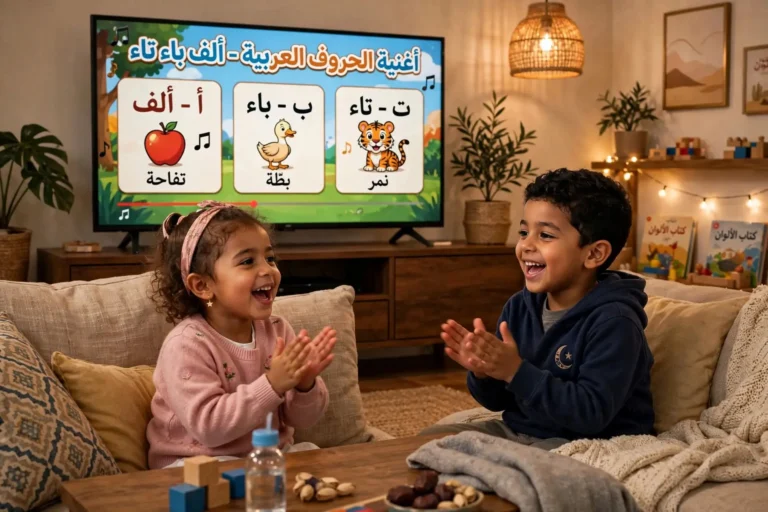
4. Songs and Rhymes
Kids remember songs way longer than they remember lists. If you can find (or make up) a simple tune that runs through the colors in order, use it. Even a made-up little chant — “أحمر، أزرق، أخضر، بس!” — works better than silent memorization.
A Few Mistakes Parents Make
I’ve seen these a lot, so let me save you the trouble:
- Rushing to sentences too soon. Your child doesn’t need “The red ball is on the table” yet. They need “أحمر” and a red ball in their hand. Sentences come later.
- Skipping repetition because it feels boring to you. It’s not boring to a four-year-old. Say the word twenty times over a week. It won’t feel like enough to you, but it’s exactly enough for them.
- Only using flashcards, never real objects. Real objects (the actual red cup, not a picture of one) create stronger memory links, especially for younger kids.
- Correcting every mistake immediately. A wrong guess followed by the right answer, gently, is fine. A wrong guess followed by “no, that’s wrong” three times in a row is how kids start avoiding the activity altogether.
Building on This: What Comes Next
Once colors feel comfortable — and that might take a few days or a few weeks, every kid’s different — you’re ready to layer in more. Numbers pair really naturally with colors (“two red apples,” “three blue cars”), so that’s often the next logical step.
If you haven’t already, take a look at our Arabic numbers article for the natural next stage, or check out our full Arabic for Beginners course if you want a structured path instead of piecing lessons together on your own.
The Bottom Line
Colors are a small vocabulary set, but they’re a genuinely great entry point into Arabic for kids. They’re visual, they’re everywhere, and they don’t need grammar to be useful right away. Start with the eleven words above, play a few games, skip the masculine/feminine rules for now, and let repetition do the heavy lifting.
That’s really it. No secret method, no fancy curriculum needed for this one — just consistent, playful exposure.
Want more structured lessons like this one, built specifically for young learners? Explore our courses and see what fits your child’s pace.