You want your kid to learn Arabic. Great. Now you’re stuck on the next question: do you sign them up for a class down the street, or let them learn from a teacher on a screen?
I’ve heard this question from parents hundreds of times. And I’ll be straight with you: there’s no answer that works for every family. Anyone who tells you otherwise is selling something.
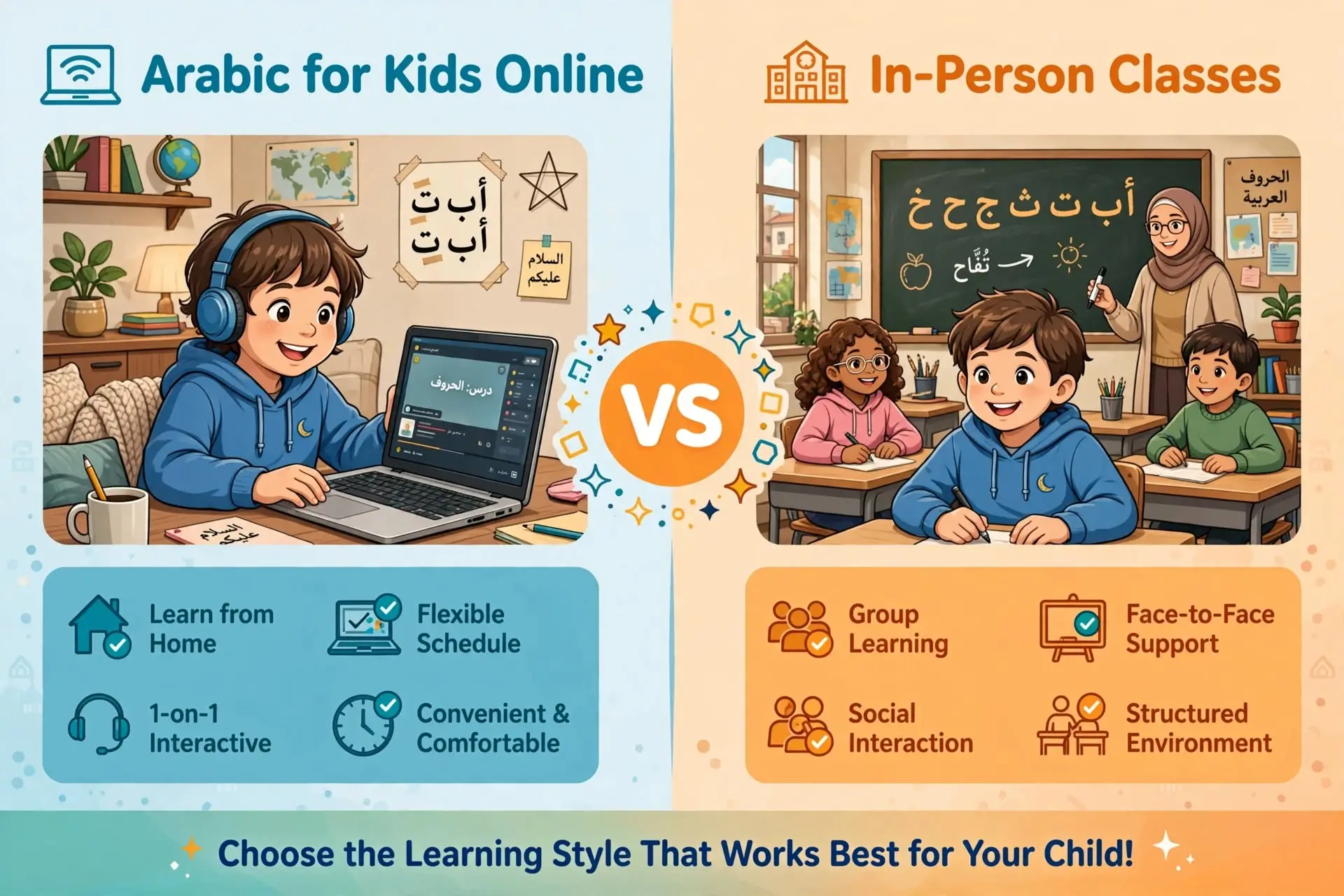
But there is a way to figure out which one fits your child. That’s what this article is for. We’ll compare both options on the things that actually matter: teacher quality, cost, schedule, attention, curriculum, and social life. Then I’ll tell you where I land, and why.
The short answer
If you live near a great in-person Arabic program, your child likes group settings, and your schedule is flexible, in-person can work really well.
If you don’t have a good local option, or you want a specific dialect, flexible times, or one-on-one attention, online usually wins.
Most families I talk to fall into the second group. But keep reading, because the details matter.
What we mean by “online” and “in-person”
Quick definitions, because these terms get fuzzy.
In-person classes are physical classes: a weekend Arabic school, a mosque or community center program, a language center, or a private tutor who comes to your home.
Online classes are live lessons over video with a real teacher. Not pre-recorded videos. Not an app where your child taps pictures. A live human who responds to your kid, corrects them, and adjusts on the spot.
That last point matters. Apps and recorded courses are a different thing entirely. Here we’re comparing live teaching in two different settings.
1. Teacher quality and access
This is the big one. The teacher matters more than the format, every time.
A great teacher in a mediocre setting beats a mediocre teacher in a perfect classroom. So the real question is: who can you actually get?
In-person: You’re limited to whoever lives near you. In some cities that’s fantastic. Big cities with large Arab communities often have excellent options. In other places, there might be one weekend school, and the teacher might be a well-meaning volunteer with no training in teaching kids a second language.
Being a native speaker doesn’t make someone a good teacher. I say this with love. Speaking Arabic and teaching Arabic to a seven-year-old who’s never heard it are very different skills.
Online: Your pool is huge. You can pick a teacher trained in teaching Arabic as a foreign language, who knows how to work with children, and who speaks the dialect you want. You can also switch teachers if it’s not a good fit, without moving house.
Edge: Online, mostly because of choice. But a great local teacher cancels this out. If you’ve found one, that’s a real advantage.
Not sure what to look for in a teacher? Check out our guide on choosing an Arabic tutor
2. Cost
Money matters. Let’s talk about it honestly.
In-person group classes are often the cheapest per hour. Community programs especially. But watch the extras: registration fees, books, and the gas and time spent driving there and back twice a week. Private in-person tutors tend to cost more, because the teacher also pays for travel time and local rent.
Online pricing varies a lot. Group classes can be very affordable. One-on-one lessons cost more than a group seat, but you’re getting a teacher’s full attention for the whole session. And you’re not paying for transport.
Here’s the thing most parents forget: cost per hour isn’t the same as cost per result. A cheap class where your child sits bored for 60 minutes and learns nothing is expensive. A pricier class where they actually speak, and want to come back, is a bargain.
For our current rates, see our pricing page
Edge: Depends. In-person group classes win on raw price. Online wins on value if you count travel and attention.
3. Convenience and schedule
Let’s be real. Parents are tired.
In-person means a fixed time and a fixed place. You drive, you wait, you drive back. If your child is sick, or there’s traffic, or you have two other kids with their own activities, it falls apart quickly. Many in-person programs run only on weekends, which means your child gives up the one free day they have.
Online means your child learns from the living room. No commute. Lessons can happen after school, on a Tuesday evening, or at 7 a.m. before everything else starts. If you travel, or move, or the family spans time zones, lessons follow you.
I’ve seen kids keep up with Arabic for years purely because it was easy to fit in. Consistency beats intensity. Always. A child who has a 30-minute lesson twice a week for two years will far outpace a child who does a big weekend block for three months and then drops out.
Edge: Online. It’s not even close here.
4. Attention and engagement (the part parents worry about most)
“My child can’t sit in front of a screen for an hour.” I hear this all the time. And honestly? You’re right to worry.
Let’s break it down by age.
Ages 4 to 6: Online can be harder. Little kids have short attention spans, and they learn through movement and play. A good online teacher uses games, songs, puppets, and shorter sessions (20 to 30 minutes). A parent nearby helps. But an in-person class with physical activities can feel more natural for this age group.
Ages 7 to 12: Online works really well here. Kids this age are used to screens, and a good teacher can use interactive tools, digital games, and quick feedback to keep them hooked. Many kids actually pay more attention in one-on-one online lessons because there’s nowhere to hide. In a class of fifteen, a shy child can go a whole hour without speaking. Online one-on-one, that’s impossible.
Ages 13 and up: Both work. Teens usually care more about whether the teacher is engaging and whether the content feels relevant than about the format.
And here’s something people skip over. In a big in-person class, your child might get two minutes of real speaking time per session. In a one-on-one online lesson, they might speak for 20. Over a month, that gap adds up to something huge.
Edge: Depends on age. In-person is better for the youngest kids. Online is often better from around age 7.
5. Curriculum and dialect
This is where a lot of parents get surprised.
Arabic isn’t one language the way English is. There’s Modern Standard Arabic (MSA), used in books, news, and formal settings, and there are spoken dialects like Egyptian, Levantine, Gulf, and Moroccan. They differ quite a bit.
So ask yourself: what’s the goal? Reading the Quran? Talking to grandparents in Cairo? Passing a school exam? Each one points to a different path.
In-person: Programs often teach one fixed thing, usually MSA or whatever dialect the teacher speaks. If it doesn’t match your goal, you’re stuck with it.
Online: It’s far easier to find a teacher and curriculum that match exactly what you want. Want Egyptian Arabic for family visits? You can find it. Want to start with the alphabet and build up? Done.
If your child is a complete beginner, our Arabic for Beginners course is built exactly for that: starting from letters and sounds, step by step.
Edge: Online, thanks to flexibility. But a strong structured in-person program with a clear curriculum can be just as good.
6. Social interaction and community
I’ll be fair here, because this is where in-person really shines.
Kids learn language from other kids. Playing, joking, and even arguing in Arabic with friends builds real fluency and makes the language feel alive. A physical classroom, especially one connected to a community, gives kids that sense of belonging. They see Arabic as something other people their age do too.
Online can offer this through small group classes and virtual communities, and it works well. But I won’t pretend it’s identical. Screens are not the same as playground chaos.
If your child is the only one in their friend group learning Arabic, a local class can make them feel less alone. That’s worth a lot.
Edge: In-person. This is its strongest point.
7. Safety and parent involvement
In-person: You know where your child is. You can meet the teacher face to face. You can see the room. That peace of mind is real.
Online: You’ll want to be around, especially with younger kids. Sit nearby for the first few lessons. Check that the platform is secure, the teacher is vetted, and sessions can be observed. Reputable academies make this easy. Parents are welcome to listen in.
On the flip side, online gives you a clear window into what’s happening. You hear exactly what’s being taught and how your child responds. In big in-person classes, parents often wait outside and have no idea what happened until the car ride home.
Edge: Tie. It depends on the provider, not the format.
Side-by-side comparison
| Factor | In-Person | Online |
|---|---|---|
| Teacher choice | Limited to your area | Wide, worldwide |
| Cost | Cheap for groups, plus travel | Flexible, no travel |
| Schedule | Fixed, often weekends | Flexible |
| Ages 4–6 | Often a better fit | Works with short, playful sessions |
| Ages 7+ | Good | Often excellent |
| Speaking time per child | Low in big groups | High in one-on-one |
| Dialect/curriculum control | Limited | High |
| Social interaction | Strongest | Good in small groups |
When in-person is the better choice
Go in-person if:
- There’s a well-run, well-reviewed program near you with qualified teachers.
- Your child is very young (4 to 5) and needs movement and hands-on play.
- Your child loves group settings and thrives with friends.
- Social connection to a local Arab community is a major goal.
- The schedule fits easily into your family’s routine.
If that’s your situation, honestly, go for it. Don’t let anyone talk you out of a good local class.
When online is the better choice
Go online if:
- There’s no strong local option, or the nearest one is a long drive.
- You want one-on-one attention and lots of speaking time.
- You need flexible scheduling around school, sports, or travel.
- You want a specific dialect or goal, like Egyptian Arabic for family visits.
- Your child is 7 or older and comfortable with screens.
- Your child is shy and needs a calm space to build confidence.
- You’ve tried in-person and it didn’t stick.
I’ll say this plainly: for most of the families I work with, online ends up being the better fit. Not because in-person is bad, but because life is busy and good local options are rare. A lesson that actually happens every week beats a perfect class you can’t get to.
How to make online work for your child
Online isn’t magic. It works when you set it up properly. A few things I’ve learned:
- Keep sessions short for young kids. 25 to 30 minutes is plenty at ages 5 to 7.
- Pick a consistent time. Same days, same hour. It becomes routine.
- Remove distractions. Quiet room, tablet or laptop on a stable surface, no siblings running through.
- Stay nearby at first. Not hovering. Just present.
- Practice a little between lessons. Five minutes a day of review beats one long session a week.
- Choose a teacher who plays. If your child isn’t smiling by lesson three, ask for a different teacher. Seriously.
For the bigger picture on getting started, read our complete guide: Learn Arabic for Kids
Don’t decide blind: try before you commit
Here’s my best advice, whichever way you lean. Test it.
Most good programs, online or in-person, offer a trial lesson. Use it. Watch how your child reacts. Do they speak? Do they laugh? Do they ask when the next class is? Those signs tell you more than any article, including this one.
Pay attention to the teacher, too. Do they get down to your child’s level? Do they correct gently? Do they explain why something works, rather than just saying “repeat after me”?
And don’t stress about picking wrong. Kids are adaptable. If something isn’t working, you can switch. What you can’t do is wait years and hope motivation appears on its own.
So, which one should you choose?
Let me wrap this up without any fancy summary.
In-person gives you community and a physical classroom. Online gives you choice, flexibility, and a lot more speaking time per child. If you have an excellent local program, try it. If you don’t, or if your schedule is packed, online is probably your best shot at consistent progress.
At Alphabet Arabic Academy, our lessons are live, taught by trained teachers, and built around how kids actually learn: through play, speaking, and lots of encouragement. We’re obviously a bit biased toward online. We built the academy around it. But I’ve tried to give you the full picture here, because the right choice is the one your child will actually stick with.
Want to see how it feels for your child? Book a free trial lesson and decide for yourself. No pressure, no commitment.