
Your child finishes a page of Quran. It sounds nice. Mostly right. But something’s off, and you can’t say what.
Maybe the “ق” sounds like a “ك”. Maybe a long vowel got clipped. Maybe every letter comes out in the same flat tone. You feel the mistake, but you don’t have the words for it.
That’s what tajweed is for. It’s the set of rules that tells us how each letter and sound should come out, so the Quran is recited the way it was taught.
Here’s the good news. You don’t need to teach all of it. Not even close. Kids learn tajweed in small pieces, and the order matters more than the speed.
So here are 10 rules, in the order I’d teach them. Each one has a kid-friendly way to explain it. If you want the bigger picture of how Arabic and Quran fit together for children, our complete parent guide to learning Arabic for kids covers it.
First, a quick reality check: what age should kids start tajweed?
Short answer: you can start listening-based practice around age 5. Formal rules usually click from 7 or 8.
Younger kids don’t need terms like “ikhfa.” They need to hear the right sound and copy it. The names come later. Our Quran & Tajweed course is built for ages 5 to 14, and the early lessons are almost all repetition and play.
Now the list.
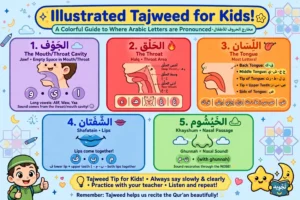
1. Makharij: where each letter comes from
Every Arabic letter has a home in the mouth or throat. That home is called its makhraj (plural: makharij).
There are five main areas:
- The empty space of the mouth and throat (for the long vowels)
- The throat
- The tongue
- The lips
- The nose (for the nasal sound)
How to teach it: Don’t start with a chart. Start with feeling. Have your child put a hand on their throat and say “ع”. Then say “ب” and watch the lips close. They’ll feel the difference before they can name it.
Honestly, this is the rule that fixes the most mistakes. Most of the “it sounds slightly off” problems come from letters that left the wrong spot.
2. Short vs. long vowels (Madd)
Arabic has short vowels (fatha, kasra, damma) and long ones. Long vowels get stretched for two beats. That’s the basic madd.
Look for three signs: an alif after a fatha, a ya after a kasra, a waw after a damma.
How to teach it: Tap the table. Two taps for a long vowel. Not one, not five. Kids love the physical rhythm, and it keeps them from dragging every vowel out like a song.
Later you’ll meet longer madd types. Skip them for now. Master the two-beat one first.
3. Heavy and light letters
Some letters sound full and “fat.” Others sound thin. In Arabic, this is tafkheem (heavy) and tarqeeq (light).
Seven letters are always heavy: خ ص ض غ ط ق ظ. Teachers often use a little phrase to remember them: khuss dhaghtin qiz.
How to teach it: Use your mouth shape. For heavy letters, the back of the tongue rises and the sound feels deep. Say “ص” and then “س” back to back. Same idea, totally different weight. Kids hear it right away.
If your child mixes up ص and س, or ق and ك, this is the rule to work on.
4. Ghunnah: the nose sound
Ghunnah is a soft nasal hum. It shows up on a noon or meem with a shaddah (نّ and مّ), and it lasts about two beats.
How to teach it: Have your child hold their nose gently while saying “إنَّ.” If the sound stops, it’s coming from the wrong place. The hum should want to come through the nose.
Silly? A little. Does it work? Every time.
5. Qalqalah: the bounce
Five letters bounce when they carry a sukoon: ق ط ب ج د. The easy phrase to remember them is qutb jad.
The sound isn’t a vowel. It’s a tiny echo, like a ball hitting the ground once.
How to teach it: Use an actual ball. Say “اَقْ” and bounce the ball on the “ق.” Kids remember qalqalah longer than almost any other rule, because they got to play while learning it.
Here’s the thing: if you’ve got a more active child who zones out during theory, start with this rule. A quick win builds confidence for the harder ones. If your child likes movement and play, our post on Arabic games for kids has more ways to keep lessons hands-on.
6. Noon sakinah and tanween
This one sounds scary, but the idea is simple. When a noon with a sukoon (نْ) or tanween comes before certain letters, it changes how it’s pronounced. There are four outcomes:
- Idhhar (clear): the noon is said clearly before the six throat letters: ء هـ ع ح غ خ
- Idgham (merging): the noon blends into the next letter. The letters are ي ر م ل و ن
- Iqlab (flipping): before the letter ب, the noon turns into a meem sound
- Ikhfa (hiding): before the other 15 letters, the noon is half-hidden with a nasal hum
How to teach it: Don’t hand over all four at once. Start with idhhar and iqlab, since they’re the easiest to hear. Add idgham and ikhfa over the following weeks.
I’ll be straight with you: this is the rule where kids (and parents) most often get lost. Slow down here. A month on this rule is normal.
7. Meem sakinah
This is the little sibling of rule 6, and it’s much easier. When a meem has a sukoon (مْ), three things can happen:
- Before ب, the meem is hidden with a light hum (ikhfa shafawi)
- Before another م, the two merge (idgham shafawi)
- Before any other letter, the meem is pronounced clearly (idhhar shafawi)
How to teach it: Three outcomes, three colors. Highlight them in the mushaf or a printed page. Visual cues help kids spot the pattern fast.
8. The “laam” in Allah
The name of Allah (الله) has a special rule. The laam is heavy after a fatha or damma, and light after a kasra.
Compare “قالَ اللهُ” (heavy) with “بِسْمِ اللهِ” (light).
How to teach it: Let your child listen to both before explaining anything. Kids hear this difference naturally. Then give them the rule as a shortcut for what their ears already caught.
9. Sun letters and moon letters
When “ال” comes before a word, the laam sometimes disappears in speech.
- Moon letters (like ق in القمر): the laam is pronounced. Al-qamar.
- Sun letters (like ش in الشمس): the laam is silent and the next letter doubles. Ash-shams.
There are 14 of each.
How to teach it: The names do half the work. Moon letters keep the laam visible. Sun letters swallow it. A simple sorting game with picture cards makes this stick fast.
10. Waqf: how to stop
Kids need to know how to stop at the end of an ayah or a breath. The basic rule is simple: when you stop, you stop on a sukoon. The last vowel isn’t pronounced.
So “الرَّحِيمِ” is read as “ar-raheem” at a pause, with no final “i” sound.
How to teach it: Teach stopping at the end of each ayah first. Waqf in the middle of a ayah comes later, and it’s a bigger topic. Keep it simple at the start.
How to practice at home (without making it a battle)
You’ve got the rules. Now, how do you actually use them?
A few things that work:
- Ten minutes, daily. Not an hour on Sunday. Short and regular beats long and rare.
- One rule at a time. Don’t move on until your child can hear it, not just recite a definition.
- Listen first. Play a good reciter, then let your child repeat the same ayah. Imitation is how tajweed has always been passed down.
- Praise the effort. Say “I loved how you bounced that qalqalah.” Not “you got it wrong again.”
- Record them. Kids are shocked and proud when they hear themselves improve.
If your child also wants to understand the meaning of what they’re reciting, that’s a different skill and a great one to build alongside. Our guide to Quran Arabic for kids explains how to bridge reciting and understanding.
Can you teach tajweed without a teacher?
Honestly? Not fully.
You can teach the ideas at home. Books, videos and apps are useful for that. But none of them can hear your child and say, “Your ع is coming from the wrong place. Try again.”
Tajweed is an oral tradition. The correction is the lesson. A live teacher catches the tiny mistakes you won’t hear (and shouldn’t have to), and gives gentle feedback before bad habits set in. Those habits are way harder to undo later.
Not sure what to look for in a teacher? Our post on choosing an online Arabic tutor for kids lists what to check before you pay.
Common mistakes parents make
A few quick ones I see all the time:
- Rushing to memorize. Memorizing a surah with wrong pronunciation locks in the mistakes. Fix the sound first.
- Teaching all the rules at once. Overload leads to frustration, then avoidance.
- Correcting too harshly. If Quran time feels like a test, your child will dread it.
- Skipping the basics. If letter sounds aren’t solid, advanced rules won’t stick. A child still shaky on the alphabet may do better starting with Arabic for beginners first.
Ready to see your child recite with confidence?
Our Quran Recitation & Tajweed course teaches these rules step by step, using repetition, games and visual cues. It’s built for ages 5 to 14, with a teacher who corrects gently and a pace that fits your child. Classes start from $40/month.
The easiest way to find out if it fits is to try it.
👉 Book a Free Trial Class and let your child meet the teacher. No pressure, no commitment. You can also see the full details on the Quran & Tajweed course page.