How to Teach a Child the Arabic Alphabet at Home

So your kid wants to learn Arabic. Or maybe you want them to learn Arabic. Either way — you’re sitting there wondering where to even start.
I get it. Arabic looks intimidating. The letters are unfamiliar. They connect. They change shape. And if you didn’t grow up with Arabic yourself, the whole thing can feel like you’re trying to teach your child something you don’t fully understand either.
Here’s the thing — you don’t need to be fluent to help your child learn the Arabic alphabet. You just need the right approach. And that’s exactly what I’m going to give you.
First, Let’s Be Honest About One Thing
Most parents make the same mistake when they start. They sit their kid down, open a worksheet, and try to go through all 28 letters in one go.
That doesn’t work for adults. It definitely doesn’t work for kids.
Arabic has 28 letters. Each one has up to four forms depending on where it sits in a word. But here’s the secret — for the alphabet stage, you only need the isolated form. The other shapes come later. One thing at a time.
So the first rule is this: go slow on purpose.
How Long Should Each Session Be?
Short. Genuinely short.
For kids aged 4–7: 10 to 15 minutes max. For kids aged 8–12: 15 to 20 minutes.
That’s it. Stop before they get bored. Stop before they start squirming. Leave them wanting a little more — not dreading the next session.
Three or four sessions a week is better than one long painful hour on Sunday. Consistency beats intensity every single time.
Step-by-Step: How to Actually Teach the Alphabet

Step 1: Start With the Sounds, Not the Shapes
Before your child draws a single letter, they need to hear it.
Play them Arabic letters out loud. There are tons of free YouTube videos and apps that say each letter clearly with its name and sound. Let your child just listen for the first few sessions. Repeat letters together. Make it fun — say them fast, say them slow, say them silly.
Why? Because Arabic has sounds that don’t exist in English. The “خ” (kha), the “ع” (ayn), the “غ” (ghayn). Your child’s ear needs to get comfortable with these before their hand tries to write them.
Don’t skip this step. It saves a lot of confusion later.
Step 2: Teach 2–3 Letters Per Week (Not Per Day)
Pick a pace that sticks.
Two or three new letters per week is enough. That means your child fully learns the whole alphabet in about 10–12 weeks.
That sounds slow. But here’s what happens when you rush — you finish in 4 weeks and your kid remembers 6 letters. I’ll take 3 months and full retention any day.
Start with the easier, more visually distinct letters:
- ب (Ba) — looks like a boat with one dot underneath
- ت (Ta) — same shape as Ba but two dots on top
- م (Meem) — like a small spiral
- س (Seen) — three bumps in a row
These are great starter letters because they’re simple to write and easy to remember visually.
Step 3: Use Something They Can Touch
Kids learn by doing. Worksheets are fine, but don’t stop there.
Some ideas that actually work:
- Tracing in sand or salt — pour a thin layer in a tray, let your child trace the letter with their finger
- Play-Doh letters — shape each letter out of clay
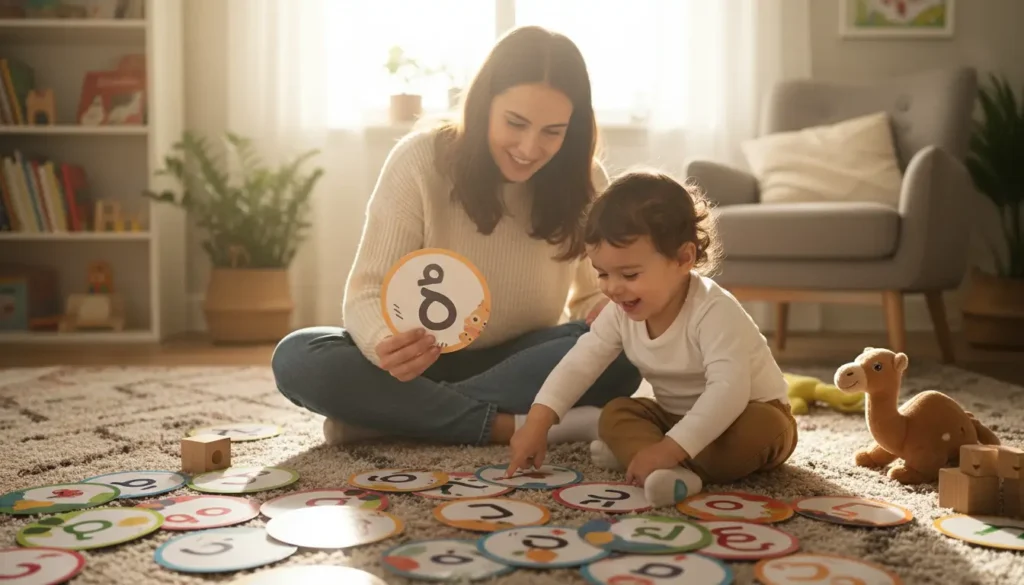
- Alphabet flashcards — simple picture + letter combinations (ب for بطة / duck, for example)
- Arabic alphabet puzzle — yes, these exist and kids love them
- Whiteboard + dry erase markers — kids will write and erase the same letter 20 times without complaining if it’s on a whiteboard
The goal is to make the letter feel real. Not just a symbol on a page.
Want a ready-made set of these activities without spending an hour hunting online? I put together a free Arabic alphabet activity pack for parents who want to start this week. [Download it here — it’s free]
Step 4: Connect Each Letter to a Word They Know
This is a big one.
Don’t just teach “ب — Ba.” Teach “ب — Ba — بطة — duck.” Or “باب — door.” Or their own name if it starts with that letter.
Meaning sticks. Random shapes don’t.
If your child’s name is Bilal or Bayan or Baraka — start with ب because it’s theirs. Ownership creates motivation. And motivation keeps kids coming back.
Step 5: Review Before You Move Forward
Every session should start with 2 minutes of review.
Before introducing a new letter, flash the ones they already know. Quick. Just a glance. “What’s this? What’s this? What’s this?” Keep it breezy, not a test.
This is called spaced repetition. And it’s the reason some kids learn the alphabet in 8 weeks and others are still shaky on it after 6 months. Review is not optional. It’s the whole game.
What If You Don’t Speak Arabic?
Honestly, this is the most common worry I hear from parents. And I’ll be straight with you — it matters less than you think.
You don’t need to be fluent. You just need to:
- Learn the letter names and sounds alongside your child (yes, you can do this)
- Use resources that provide correct audio (apps, videos, a qualified teacher)
- Be honest with your child — “I’m learning too” — kids actually love that
What does matter is that someone provides correct pronunciation somewhere in the mix. If you’re not confident in that, a good Arabic teacher for kids — even one online lesson per week — can be the anchor that makes everything else work at home.
That’s not a failure. That’s smart parenting.
If you’re not sure where to start with that, take a look at [why so many parents choose structured lessons early on] — it explains the difference it makes in the long run.
A Simple Weekly Routine That Works

Here’s what a realistic week looks like:
Monday: Introduce 1 new letter — say it, hear it, trace it Wednesday: Review all letters learned so far + practice writing the new one Friday: Play a game with the letters (matching, tracing, flashcards) Weekend: Watch a short Arabic cartoon or letter video — totally passive, totally fine
That’s four short sessions. Less than an hour total for the whole week. And it’s enough to make real progress if you stay consistent.
Common Mistakes to Avoid
Skipping the sounds. Writing a letter your child can’t pronounce creates confusion. Always sound first.
Doing too much too fast. Five new letters in one session. I’ve seen it. It doesn’t end well.
Only using worksheets. Worksheets are one tool, not the whole toolbox. Mix it up.
Stopping when it gets hard. Some letters are genuinely tricky — ع، ض، ظ. Don’t avoid them. Just spend more time on them.
Expecting perfection from the start. Arabic handwriting takes time even for native speakers. Praise effort, not neatness.
When Should You Start?
Anytime from age 4 is fine for letter recognition and sounds. Writing usually comes a bit later — around 5 or 6 — when fine motor skills are more developed.
But if your child is 8 or 10 and you’re just starting now, don’t stress about it. Older kids actually pick up letters faster because their memory and focus are stronger. It’s never too late to start.
And if you want a full picture of how to take your child from zero to reading Arabic — not just the alphabet — check out our guide on [learning Arabic for beginners]. It covers what comes after the letters.
Want a Head Start?

https://arabicforkidsonline.com/If you want your child to learn the Arabic alphabet properly — with the right pronunciation, fun lessons, and a real structure — our Arabic for Kids course at Alphabet Arabic Academy is built exactly for this.
Short lessons. Designed for young learners. And you don’t need to speak Arabic to follow along.
👉 [Book a free trial lesson here] and see if it’s the right fit for your child.
No pressure. Just one lesson. See how they respond.
Teaching your child the Arabic alphabet at home is absolutely doable. You don’t need a degree in Arabic. You don’t need hours a day. You just need a plan, a little patience, and short sessions that don’t burn anyone out.
Start with the sounds. Go slow. Review constantly. And celebrate every single letter they get right.
That’s how it works. Simple as that.