Your kid has been staring at a screen for two hours. You feel bad about it. Then you remember you also wanted them to practice Arabic this week.
Sound familiar?
I hear this from parents all the time. They want Arabic games for kids, but they’re tired of apps that turn into glorified cartoons. Or they simply want something that gets the kids off the couch.
Good news. You don’t need a tablet. You don’t need to buy anything fancy. And you definitely don’t need to speak perfect Arabic yourself.
Here are 10 offline games I’ve used with real kids, from 3-year-olds to 10-year-olds. Some take two minutes to set up. Some take zero.
Why Games Work Better Than “Lessons”
Quick reality check before the list.
Kids don’t learn a language by sitting still and repeating words. Not for long, anyway. Five minutes in and they’re counting ceiling tiles.
Games change that. When a child is hunting for a letter or racing to shout a number, they stop thinking “I’m studying.” They just play. And the Arabic sticks, because it’s attached to a memory, a laugh, a win.
That’s the whole secret. Play first. Learning rides along.
If you want the bigger picture on how all of this fits together, my complete parent guide to learning Arabic for kids covers the full roadmap. This article is the fun part.
1. Arabic Letter Hunt
Best for: ages 3–7
You need: sticky notes, a marker
This one’s a classic for a reason.
Write Arabic letters on sticky notes. Start small. Five or six letters is plenty. Hide them around the room. Then say the name of a letter out loud, like alif (أ), and let your child race to find it.
Found it? They stick it on the fridge, the door, wherever you choose as the “letter wall.”
Make it harder by hiding two notes with the same letter in different shapes (beginning, middle, end of a word). Older kids love that challenge.
Parent tip: Don’t know the letters yourself? Learn them together. Honestly, kids enjoy beating a parent at this. Let them win a few times.
Stuck on where to start with the alphabet? Here’s a step-by-step guide on how to teach a child the Arabic alphabet at home.
2. Arabic Bingo
Best for: ages 4–9
You need: paper, pencil, small objects for markers (buttons, coins, cereal)
Draw a 3×3 grid for little ones, or 4×4 for older kids. Fill each square with a letter, a number, or a simple word. Make a few different cards so everyone’s board is different.
Call out items one at a time. Kids cover the matching square. First to fill a row shouts “Bingo!” (yes, in English. That’s fine.)
Here’s a nice twist. Call out the sound, not the name. Say “ba” and they find ب. It trains the ear, not just the eye.
Play it with numbers too: واحد (wahid), اثنان (ithnan), ثلاثة (thalatha). You can go deeper with our guide to Arabic numbers for kids.
3. Memory Match
Best for: ages 3–8
You need: index cards or cut-up paper
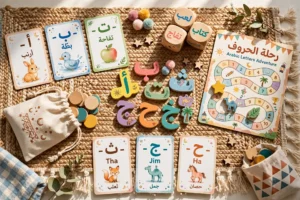
You make pairs. One card has the Arabic word. The other has a picture. Cat and قطة (qitta). Apple and تفاحة (tuffaha). Flip them face down, take turns turning over two cards, and match them up.
Rule: you have to say the Arabic word out loud when you flip it. No silent turns.
Here’s the thing. You don’t have to draw all these cards from scratch. I put together a whole set of free printable ideas in my Arabic flashcards for kids article. Print them twice, and boom, you’ve got a memory game.
4. Simon Says, Arabic Style
Best for: ages 3–8
You need: nothing at all
I love this one because it costs nothing and burns energy.
You’re “Simon” (or “المعلّم,” al-mu’allim, the teacher). Give commands in Arabic. Kids only follow if you say the magic phrase first.
Start with these:
- قِف (qif) — stand
- اِجلِس (ijlis) — sit
- اِقفِز (iqfiz) — jump
- اِمشِ (imshi) — walk
- اِرقُص (urqus) — dance
Demonstrate the action the first few rounds. After that, drop the demo and let them figure it out from the word alone. That’s when real learning kicks in.
Swap roles often. A kid giving the commands is practicing speaking, which is harder than listening. And more valuable.
5. “I Spy” With Colors
Best for: ages 3–7
You need: your eyes
Classic I Spy, but in Arabic. Say:
“أنا أرى شيئاً لونه أحمر” (ana ara shay’an lawnuhu ahmar) — “I see something that’s red.”
Your child looks around, guesses, and points. When they get it, they say the color word back.
Keep the sentence the same every round. Repetition is your friend. After a few games, your kid will chant the whole phrase without thinking.
Need the color words handy? Grab them from my simple Arabic colors for kids vocabulary guide.
6. Sensory Letter Writing
Best for: ages 3–6
You need: a tray, plus salt, sand, shaving cream, or playdough
Arabic script is beautiful. It’s also a little tricky for small hands. This game makes it less scary.
Pour salt or sand onto a tray. Say a letter. Your child traces it with one finger. Wipe it flat, repeat. Or squish playdough into snake shapes and build the letter.
Is it messy? A bit. Do kids remember letters better after touching them? Absolutely.
I’ll be straight with you: this works better than worksheets for most young kids. Worksheets can wait until they’re older and want to write neatly.
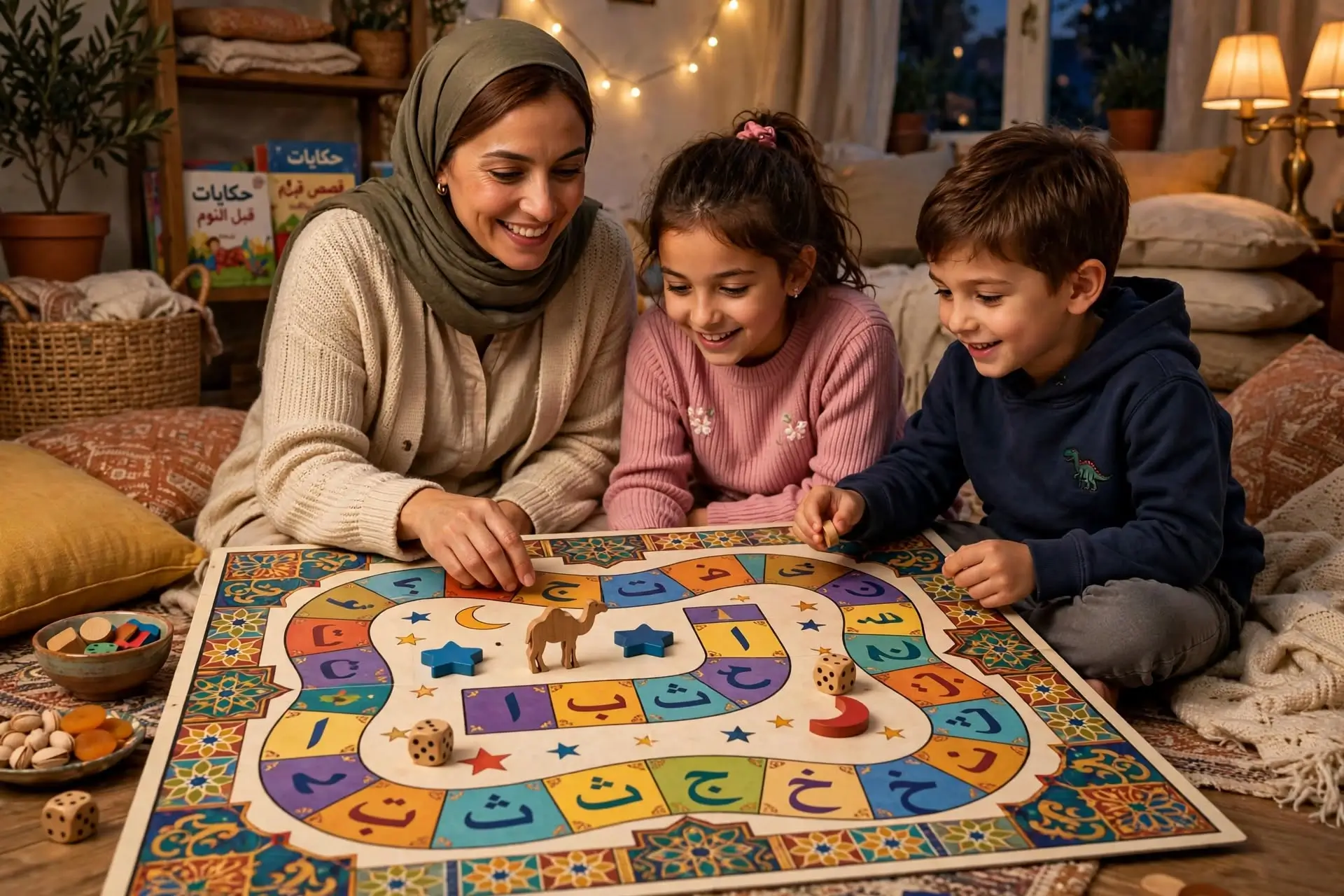
7. Arabic Board Games (DIY and Store-Bought)
Best for: ages 5–10
You need: a board game you already own, plus some paper
You don’t need to hunt down a special Arabic board game. You probably have one at home right now.
Try these hacks:
- Snakes and Ladders: Write an Arabic letter or number on each square. When you land on one, you say it before moving on. Wrong answer? Stay put.
- Uno or card games: Use number cards, and have everyone say the card in Arabic as they play it.
- Dominoes: Stick small labels over the dots with Arabic numerals.
- Candy Land-style games: Call out the color in Arabic instead of English.
If you’d rather buy something ready-made, search for bilingual or Arabic alphabet board games and check reviews from other parents first. Quality varies a lot, and some are just pretty boxes with thin content.
My honest take? The DIY versions often work better. You control the difficulty, and your kid already knows how the game works.
8. Counting Hopscotch
Best for: ages 4–8
You need: chalk (outside) or masking tape (inside)
Draw a hopscotch grid. Instead of 1, 2, 3, write Arabic numerals: ١ ٢ ٣ ٤ ٥.
Your child hops and says each number in Arabic as they land on it. Simple. Loud. Fun.
For older kids, call out a number and make them hop straight to it. Or add math: “Hop to two plus three.” That makes them read the numeral, think, and respond. All in Arabic.
Rainy day? Masking tape on the living room floor does the job. Just warn the neighbors downstairs.
9. Pretend Shop
Best for: ages 5–10
You need: toy food or kitchen items, play money, paper price tags
Set up a little store. You’re the shopkeeper first. Your child is the customer.
Teach a few simple lines:
- كَم الثَّمَن؟ (kam ath-thaman?) — How much is it?
- أُريد تُفّاحة (urid tuffaha) — I want an apple
- شُكراً (shukran) — Thank you
- عَفواً (afwan) — You’re welcome
Then flip roles. Let your child run the store while you shop. Make mistakes on purpose. Ask for the wrong thing and let them correct you. Kids love correcting adults.
Want something closer to what family and friends actually say in everyday conversation? Egyptian Arabic is a great option for that. Take a look at our Egyptian Arabic for kids course.
10. Animal Charades
Best for: ages 3–9
You need: just a bit of silliness
Pick an animal. Act it out without making a sound. Everyone else guesses in Arabic.
Start with these:
- قِطَّة (qitta) — cat
- كَلب (kalb) — dog
- أَسَد (asad) — lion
- فِيل (feel) — elephant
- سَمَكة (samaka) — fish
Then make it harder. Let the guesser say the word, and the actor has to say “نعم!” (na’am, yes) or “لا” (la, no).
Kids will crawl, roar, and flap around the living room. And they’ll remember these animal words for months. Trust me on that one.
How to Make These Games Actually Work
I’ve watched parents try these and get frustrated. Here’s what usually goes wrong, and how to avoid it.
Keep sessions short. Ten to fifteen minutes is plenty. Stop while your kid still wants more. That’s the whole point.
Don’t correct every mistake. If your child says a word slightly wrong, say it back correctly and keep playing. Constant correction kills the fun fast. Nobody enjoys a game where they’re being graded.
Repeat the same games. Parents get bored way before kids do. Your child may want Letter Hunt for the fifth day in a row. Let them. Repetition is how words move into long-term memory.
Mix in other fun stuff. Games work best alongside other low-pressure input. A good Arabic story book at bedtime helps. Check out these Arabic books for kids for ideas. And yes, a little screen time can be fine too. If you go that route, choose well with this list of the best Arabic cartoons for kids on YouTube.
Celebrate small wins. Learned three letters this week? Great. High five. Sticker. Done.
Which Game Should You Start With?
Overwhelmed by choices? Here’s a cheat sheet.
| Your child’s age | Start with |
|---|---|
| 3–4 years | Simon Says, I Spy, Sensory Letters |
| 5–6 years | Letter Hunt, Memory Match, Counting Hopscotch |
| 7–8 years | Bingo, Board Game hacks, Animal Charades |
| 9–10 years | Pretend Shop, Board Games, Bingo with words |
Pick one. Just one. Play it three times this week. Then add another.
When Games Aren’t Enough
Let me say something honestly. Games are fantastic. But they’re not a full program.
Games build fun, familiarity, and confidence. They won’t teach your child to read fluently, understand grammar, or hold a real conversation by themselves. That takes structure, a good teacher, and regular practice.
The sweet spot? Use games to keep Arabic fun at home, and pair them with live lessons that build real skills. That combo is what works for most of the families I teach.
If your child is just starting out, our Arabic for Beginners course is built exactly for this. Small steps, friendly teachers, lots of play. And if you’re curious about the different routes available, here’s a breakdown of how to choose the best way to learn Arabic for children.
Quick FAQ
What age can kids start playing Arabic games?
As early as 2 or 3. At that age it’s about sounds and movement, not reading. Simon Says and animal charades work great.
Do I need to speak Arabic to play these games?
Nope. If you can read the words on this page, you can run most of these. Learn alongside your child. They’ll enjoy it more.
How often should we play?
Little and often beats long and rare. Ten minutes a day, or even three times a week, is plenty to see progress.
Are screen-free games better than apps?
Not always “better,” but they’re different. Hands-on play builds memory and speaking confidence in a way swiping a screen doesn’t. Use both if you like, just don’t rely on apps alone.
Ready to Take the Next Step?
If your kid loves these games and you want to turn that fun into real progress, we’d love to help. Our teachers make lessons feel like play, not homework.
Explore Courses and find the right fit for your child.