Quran Arabic for Kids: A Parent’s Complete Guide

Your kid can recite Surah Al-Fatiha perfectly. Every word, every pause, right where it should be.
But ask them what “الرَّحْمَٰنِ الرَّحِيمِ” actually means, and you get a blank stare.
Sound familiar? You’re not alone. Most Muslim parents run into this exact wall. Kids memorize the sounds beautifully — that’s what Tajweed classes are built for — but the meaning part gets skipped. And honestly, it’s not anyone’s fault. Memorization and language comprehension are two completely different skills. Nobody ever told you that.
Here’s the good news: teaching your child to actually understand the Arabic in the Quran isn’t some rare gift only scholars have. It’s a skill. It can be taught, step by step, at any age. This guide is going to walk you through exactly how to start — no fluff, no overwhelming theory, just what actually works.
Why This Matters More Than You Think
Let’s be real for a second. A lot of parents figure “the memorization is the hard part, understanding can come later.” But flip that around. When a child understands what they’re saying, the memorization sticks better too. Meaning creates a hook for the words to hang on. Without it, kids are just memorizing sound patterns — and those fade fast if they’re not reviewed constantly.
There’s also the connection piece. A child who understands “الحمد لله” isn’t just saying a phrase. They’re praising God, and they know it in their bones. That’s the difference between ritual and relationship. And that difference matters for the rest of their life, not just for this Ramadan or that Quran competition.
One more thing worth saying plainly: Quranic Arabic is not the same as everyday spoken Arabic, and it’s also not quite the same as Modern Standard Arabic (MSA) that’s taught in most Arabic-for-kids programs. It has its own vocabulary, its own grammar patterns, and honestly, its own beauty. So even if your child already speaks Arabic at home, Quranic Arabic still needs its own dedicated attention.
The Big Mistake Parents Make
I’ll be straight with you — this is the mistake I see over and over. Parents wait. They think, “My child needs to finish memorizing the Quran first, then we’ll work on understanding.” Or, “Let’s wait until they’re older and can really focus.”
Both of these delay the process for years. And every year you wait, the gap between what your child recites and what they understand gets wider and harder to close.
The truth is, you can start teaching comprehension alongside memorization, from a very young age. Not the same lesson, not the same intensity — but in parallel. A five-year-old learning to recite Al-Fatiha can, at the very same time, start learning what “رب العالمين” means. It doesn’t need to wait.
Age-by-Age: How to Actually Start
There’s no single “right way” to teach Quranic Arabic to kids. What works depends heavily on age. Here’s how to break it down.
Ages 4-6: Building the Ear and the Love
At this age, forget grammar completely. Nobody’s diagramming sentences with a five-year-old. What you want here is exposure and joy.
- Play short surahs on repeat during car rides or bedtime.
- Point to Arabic letters and connect them to sounds your child already knows.
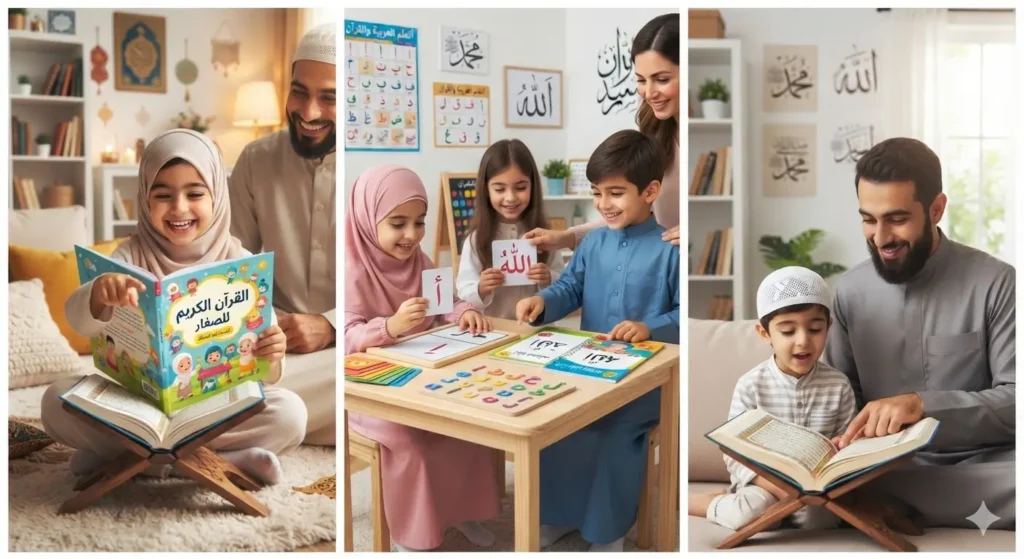
- Teach single meaningful words — “الله” (Allah), “رحمن” (Merciful), “الحمد” (praise) — through simple stories or pictures, not lectures.
- Celebrate every small win loudly. This age is about building a positive emotional association with the language, not accuracy.
Honestly, this stage is less about “teaching Arabic” and more about not accidentally teaching your kid that Arabic is boring or hard. That’s the whole game right here.
Ages 7-9: Introducing Real Vocabulary
Now your child likely knows the Arabic alphabet and can read basic words. This is where you start layering in actual Quranic vocabulary — not through drills, but through the surahs they already have memorized.
- Take a surah they know by heart (Al-Fatiha is perfect for this) and go word by word, slowly, over weeks.
- Use flashcards with the word, a simple picture, and the English meaning.
- Introduce very basic grammar ideas naturally: “this word means ‘I’, this one means ‘he’.” No formal grammar terms needed yet.
- Ask them to translate short phrases they already know by heart. When they connect “الحمد لله” to “praise be to Allah” on their own, that’s the moment it clicks.
Ages 10-12: Structure and Patterns
Kids at this age can start handling actual grammar concepts, and honestly, they often enjoy the puzzle-solving aspect of it if it’s presented right.
- Introduce Quranic Arabic grammar basics: how verbs change with different subjects, how nouns get definite articles, basic sentence structure.
- Work through short surahs word-for-word with grammar explanations, not just vocabulary.
- Start building a personal “Quran dictionary” — a notebook where they add new words as they encounter them.
- Encourage them to notice patterns across surahs. Once they realize the same root word shows up in different forms across the Quran, understanding accelerates fast.
Ages 13+: Independent Comprehension
Teenagers can genuinely start reading and analyzing Quranic Arabic somewhat independently, especially if they’ve had exposure through the earlier stages.
- Move toward tafsir (interpretation) alongside language study — understanding a verse’s meaning and its Arabic grammar together.
- Introduce root word analysis (the three-letter root system Arabic is built on). This single skill unlocks huge chunks of vocabulary at once.
- Give them real texts to work through with guidance rather than pre-chewed lessons.
- Let them ask questions about verses that confuse them. This is where real ownership of the language starts.
What If My Child Doesn’t Speak Arabic at All?
This is probably the question I get asked the most. And the answer is: it doesn’t matter as much as you think.
Here’s the thing — Quranic Arabic is learned as its own system, sound by sound, word by word, regardless of what language your child speaks at home. Kids who grow up speaking English, Urdu, French, whatever — they all start from the same place with Quranic vocabulary. It’s not like MSA where existing Arabic speakers have a head start on everyday words.
So no, your child doesn’t need to be fluent in Arabic first. What they need is consistent, age-appropriate exposure, and a clear path forward. That’s really it.
Practical Tips That Actually Work

A few things that make a real difference, based on what tends to work across different families:
Consistency beats intensity. Fifteen focused minutes a day beats a two-hour session once a week. Kids’ brains build language through repetition spread over time, not cramming.
Connect it to their existing memorization. Don’t teach random vocabulary lists. Teach the words in the surahs they already recite. It reinforces both skills at once.
Use visuals for younger kids. Pictures, colors, hand motions — anything that isn’t just staring at Arabic script helps younger children retain meaning.
Don’t skip the fun. Games, stories, even simple songs built around Quranic vocabulary keep kids engaged far longer than flashcards alone.
Track progress visibly. A simple chart where your child sees new words they’ve learned adds up fast, and kids love seeing proof of their own growth.
When to Get Outside Help
Look, plenty of parents can handle the early stages on their own, especially the 4-6 age range. But once grammar and structure come into play, having a qualified teacher makes a real difference. A good teacher knows how to pace lessons for a child’s age, catch small misunderstandings before they turn into bad habits, and keep kids motivated when things get harder.
This is exactly why we built a dedicated Quranic Arabic course for children — structured by age, focused on real comprehension rather than just vocabulary memorization, and taught by instructors who actually specialize in teaching kids (which, trust me, is a completely different skill from teaching adults).
If your child is already working on recitation and Tajweed, our Quran & Tajweed course pairs naturally with Quranic Arabic study, since understanding the words makes the recitation itself more meaningful. And if you’re starting from zero with Arabic altogether, our Beginners course builds the foundation your child needs before diving into Quranic-specific vocabulary and grammar.
The Bottom Line
Teaching your child to understand the Quran, not just recite it, isn’t complicated. It just needs to start early, stay consistent, and match your child’s age and stage. Start with love and exposure. Layer in vocabulary. Build toward grammar and structure. And when you need help, get help — there’s no prize for doing it alone.
Your child reciting the Quran is beautiful. Your child understanding what they’re reciting? That’s the part that stays with them for life.
Ready to give your child that head start? Book a free trial and see how our Quranic Arabic course fits your child’s age and level.