You’ve probably typed “arabic books for kids” into a search bar and got buried.
Hundreds of covers. Five-star reviews on everything. No idea which book your four-year-old will actually open, and which one will sit on the shelf looking pretty.
I teach Arabic to kids online, and parents ask me this all the time. So here’s my list. Fifteen picks, sorted by age and by what your child can realistically handle. Some are bilingual. Some are purely Arabic. A few teach letters, and a few are here because the story is just good.
One thing before we start. No book teaches a child Arabic by itself. Books are amazing support. But if you want real reading progress, they work best next to a teacher or a routine. I’ll show you how to pair them in a minute.
The Best Arabic Books for Kids at a Glance
The best Arabic books for kids depend on age. Toddlers do best with picture-heavy board books, ages 4 to 6 with short bilingual stories, ages 6 to 9 with letter workbooks and early readers, and ages 9 and up with classic Arabic tales read together.
Here’s the whole list in one table. Details on each pick are below.
| Age | Book | Type | Why it works |
|---|---|---|---|
| 0–4 | My First Arabic Book (Wonder House 4-book set) | Board books | Alphabet, numbers, colours, and shapes in one sturdy set |
| 0–4 | I Love Arabic: Arabic Alphabet | Alphabet book | One illustration per letter, simple and cheap |
| 0–4 | Milet Picture Dictionary (Arabic-English) | Picture dictionary | Perfect for pointing and naming games |
| 4–6 | Am I Small? | Bilingual picture book | Short, repetitive text kids pick up fast |
| 4–6 | The Rainbow Fish (English/Arabic) | Bilingual picture book | Familiar story, so they focus on the Arabic |
| 4–6 | The Swirling Hijaab | Bilingual picture book | Warm story with a cultural connection |
| 4–6 | Shelley Admont’s bilingual series | Bilingual picture books | Gentle everyday stories, great for bedtime |
| 4–6 | In the Sky (Easy Early Arabic Readers) | Early reader | Big letters, short text, made for first reading |
| 6–9 | I Love Arabic: Arabic Alphabet and Writing | Writing workbook | Links letter recognition with handwriting |
| 6–9 | My Arabic Journey, Level 1: Arabic Letters | Workbook | Structured home practice for new learners |
| 6–9 | Stepping Stones: A Refugee Family’s Journey | Bilingual picture book | Story with depth, opens real conversations |
| 6–9 | The Day Saida Arrived | Picture book | Helps kids who feel stuck in a new language |
| 9+ | Kalila wa Dimna (children’s editions) | Classic fables | Short animal tales with clear lessons |
| 9+ | Juha stories | Folk tales | Funny, short, quick wins for learners |
| 9+ | Kamel Kilani’s children’s stories | Simplified classics | Real plot for confident readers |
Book links below go to Amazon or a bookstore that ships worldwide. Editions and stock vary by country, so check what’s available where you live.
How to Pick an Arabic Book (Before You Spend a Dime)
Here’s the thing. Most parents pick based on the cover. I get it. But three checks will save you money.
1. Look for harakat (the little vowel marks).
Arabic text in most adult books skips them. A beginner can’t guess the vowels, so they get stuck fast. For young learners, you want books with full diacritics, or at least a few pages you can preview.
2. Match the book to the reading stage, not the age.
A 9-year-old who’s never seen Arabic letters isn’t ready for a 9-year-old’s chapter book. Start where they are. Nobody’s going to judge.
3. Check the translation in bilingual books.
Not every bilingual book is equal. Researchers in the UAE evaluated four English/Arabic children’s books and found that translation accuracy and cultural relevance matter, and that the pictures and the words need to work together. In plain English: flip through the Arabic text before buying. If the Arabic looks stiff or odd, skip it.
Quick note on dialect too. Most printed children’s books use fusha (standard Arabic), not the Arabic your family might speak at home. That’s normal. If you’re wondering how the two fit together, I wrote about it in our Egyptian Arabic for kids guide.
Ages 0 to 4: First Words and Shapes
At this age, your child isn’t “learning Arabic.” They’re hearing it, pointing at it, and getting used to the way it looks. That’s the whole goal.
1. My First Arabic Book (Wonder House 4-book set)
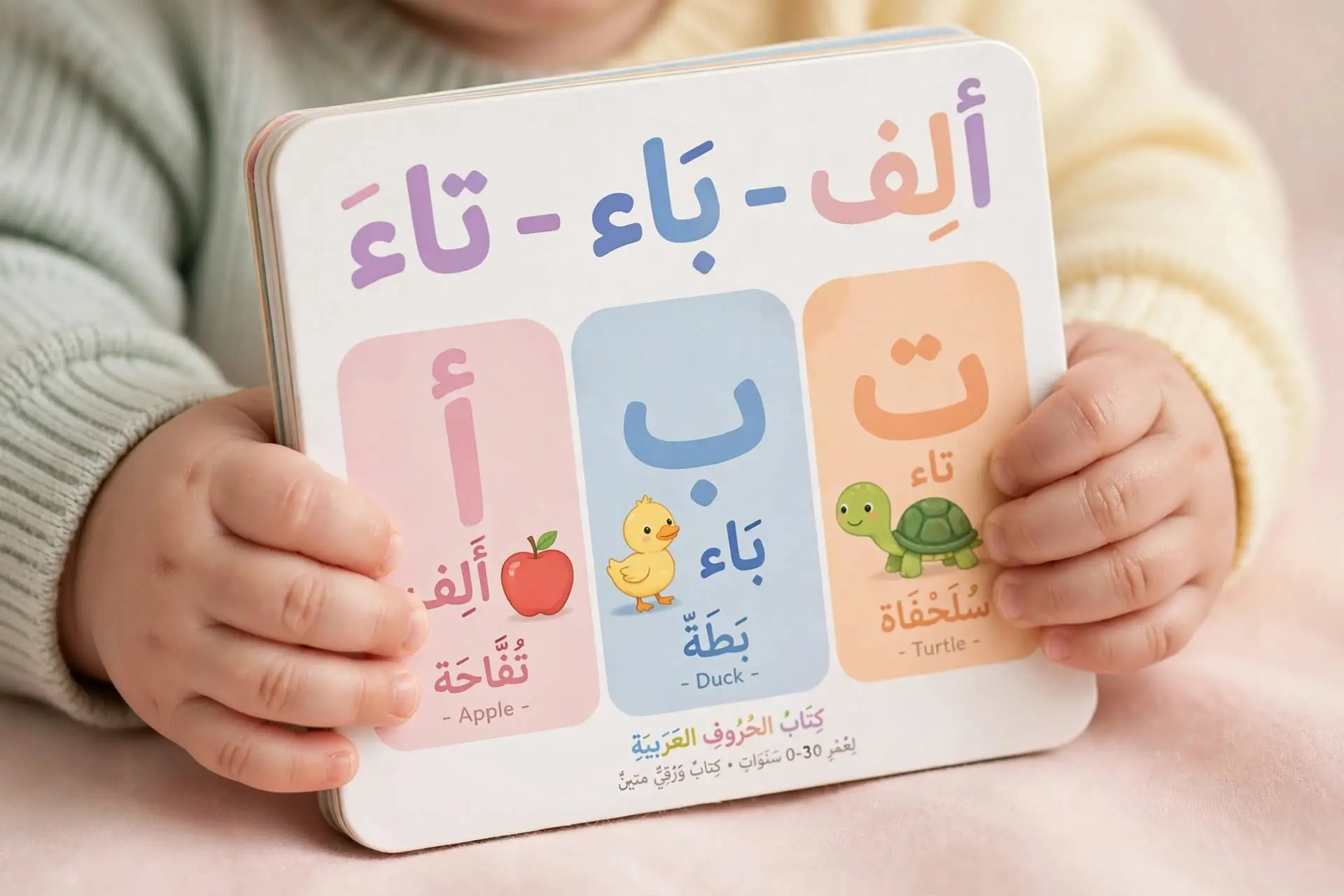
A boxed set of four board books covering the Arabic alphabet, numbers, colours, and shapes, with English translations. The board book format is sturdy for small hands. It’s a good first purchase because one set covers the basics, and the pages survive chewing and dropping.
Best for: toddlers and preschoolers. Skip it if: your child already reads letters. They’ll find it too easy.
Find it on Penguin Random House →
2. I Love Arabic: Arabic Alphabet (Goodword)
The first book in the I Love Arabic series. Each letter gets its own illustration, and the book works on identifying and sequencing letters. It’s simple and it’s cheap. Check the age range on the listing you buy from, because sellers list it differently.
Best for: kids starting the alphabet for the first time.
Find it on Darussalam →
3. Milet Picture Dictionary (Arabic-English)
A picture dictionary isn’t a story. But toddlers love pointing at things and naming them. Keep it on the coffee table. Ask “where’s the apple?” in Arabic. Five minutes. Done.
Best for: building a first vocabulary through pointing games.
Find it on Amazon →
If your child loves this kind of word-and-picture play, our free Arabic flashcards for kids are a perfect partner. Use the book for the pictures and the cards for the review.
Ages 4 to 6: Picture Books and Bilingual Stories
This is the sweet spot for bilingual Arabic books for children. They’re old enough to enjoy a real story, and young enough to forgive slow reading.
4. Am I Small? by Philipp Winterberg and Nadja Wichmann
A little girl named Tamia isn’t sure whether she’s small, so she asks the different animals she meets on her journey. It’s short and repetitive, and that’s exactly why it works. Kids pick up the Arabic phrase by the third page. Make sure you pick the English-Arabic edition, since the author published it in many language pairs.
Best for: first bilingual read-aloud.
Find it on Amazon →
5. The Rainbow Fish, English/Arabic Bilingual Edition by Marcus Pfister
You may already know the story. It’s about a shiny fish who has to learn to share. That’s actually the trick here. When your child knows the plot, they can focus on the Arabic words instead of decoding the story at the same time.
Best for: kids who already love the English version. Familiar story, new language.
Find it on Amazon →
6. The Swirling Hijaab by Na’ima B. Robert
A little girl and her mum’s big, swirling hijab. It’s warm and imaginative, and it’s a lovely pick for families who want Arabic books that reflect their own homes. It was published as a bilingual edition, so it works for English-first readers.
Best for: families who want stories with a cultural connection.
Find it on Amazon →
7. Shelley Admont’s bilingual series (I Love to Share, I Am Thankful, Goodnight, My Love!)
This is a big series. Titles in the English/Arabic line include I Love to Share, I Am Thankful, Goodnight, My Love! and I Love to Eat Fruits and Vegetables. They’re gentle stories about everyday life and good manners, and the number of titles means you can keep going once your child is hooked.
I’ll be straight with you: quality across a big series can vary. Preview the Arabic first. If it reads naturally, buy more. If not, move on.
Best for: bedtime reading and building a routine.
Find the series on Amazon →
8. In the Sky (Easy Early Arabic Readers) by Umm Sumayyah Quan
A proper early reader, listed as a bilingual Arabic and English picture book in the Easy Early Arabic Readers line. Short text, big letters, and the aim is for your child to read it themselves, not just listen.
Best for: the moment your child starts sounding out words.
Find it on Amazon →
Ages 6 to 9: Reading Practice and First Real Stories
At this stage, kids can start reading Arabic themselves, slowly. Here’s where I’d mix workbooks with story time.
9. I Love Arabic: Arabic Alphabet and Writing
The second book in the series. It teaches children to identify Arabic letters, sequence them, and write them. Reading and writing are linked in Arabic because letters change shape depending on where they sit in a word. Writing practice helps recognition. So pair this with story time, not instead of it.
If your child struggles with the letters themselves, start with our guide on how to teach a child the Arabic alphabet at home.
Best for: kids who know some letters and need handwriting practice.
Find it on Amazon →
10. My Arabic Journey, Level 1: Arabic Letters
A workbook rather than a storybook. It’s a 110-page paperback in English, independently published in 2024 and designed for new Arabic learners. A good “Tuesday afternoon” activity when story time feels like too much.
Best for: structured practice at home. It’s independently published, so preview the pages if you can.
Find it on Amazon →
11. Stepping Stones: A Refugee Family’s Journey by Margriet Ruurs and Nizar Ali Badr
This one is different from everything above. It was inspired by the stone artwork of the Syrian artist Nizar Ali Badr, and it tells a story about the Syrian refugee crisis in a bilingual edition for ages 4 to 8.
It’s a heavier topic. I’d read it together, not alone. But it’s beautiful, and it opens real conversations.
Best for: families who want a story with depth.
Find it on Amazon →
12. The Day Saida Arrived by Susana Gómez Redondo
A picture book for ages 3 to 7 in which two girls bridge a language barrier and form a lasting friendship. It isn’t a language lesson. It’s about what it feels like not to share a language with someone, and that helps a child who’s learning Arabic and feeling frustrated.
Best for: kids who feel embarrassed about not knowing enough yet.
Find it on Amazon →
Ages 9 and Up: Classic Arabic Stories
These are the real Arabic storybooks. Traditional tales, written in Arabic, with more complex language. Honestly, most kids learning Arabic as a second language won’t read these alone until later. That’s fine. Read them to your child, or with a teacher.
13. Kalila wa Dimna (children’s editions)
A classic collection of animal fables that’s been retold for centuries. The animals are the characters, and each story has a lesson about friendship, trust, or cleverness. Look for a children’s edition with harakat. The original is far too hard for a beginner.
Best for: read-aloud time with older kids.
Find editions on Amazon →
14. Juha stories
Juha is a folk character known across the Arab world, a funny man who does silly things and somehow ends up wise. The stories are short, which is great for learners. Each one is a mini adventure in about a page.
Best for: kids who like humor. Short chapters mean quick wins.
Find editions on Amazon →
15. Kamel Kilani’s children’s stories
Kamel Kilani was an Egyptian writer known for simplified stories for young readers. If your child is past the picture-book stage and wants more plot, this is a classic place to look. Check for diacritics in the edition you choose.
Best for: confident readers moving into short chapter stories.
Find editions on Amazon →
So Which One Should You Buy First?
You don’t need all fifteen. Please don’t buy all fifteen.
- Age 0 to 4: pick #1 and #3.
- Age 4 to 6: pick #4 and one more bilingual story (#5 or #7).
- Age 6 to 9: pick #9 or #10 plus #8 or #11.
- Age 9+: pick one classic (#13 or #14) and read it together.
Two or three books, used every day, beat a shelf of unopened ones. Every time.
How to Actually Use These Books (This Is the Part That Matters)
Buying books is the easy part. Here’s what works.
Read 10 minutes. Not 30. Short and daily beats long and rare.
Let them hold the book. Point to words as you read. Let them turn the pages. Remember Arabic goes right to left, and a bilingual book can feel backwards at first. Let them figure that out.
Don’t correct every mistake. Seriously. If your kid says a word wrong, say it back correctly and keep going. Stopping every few seconds kills the fun.
Mix it up. Books are one tool. Pair them with something light. Our list of Arabic cartoons for kids on YouTube is great for ear training, and a book then gives the eyes something to do. Short numbers and colors games help too, so check out our guides to Arabic colors and Arabic numbers.
If you want the full roadmap beyond books, start with our complete parent guide to learning Arabic for kids.
When Books Aren’t Enough
Let me be honest with you. Books can’t tell your child that they pronounced a letter wrong. They can’t notice that your daughter keeps mixing up two letters that look similar. And they can’t adjust when your son is bored.
That’s where a teacher comes in. A good one watches how your child reads, fixes small problems early, and keeps lessons fun. If you’re comparing options, our guide on what to look for in an online Arabic tutor for kids will save you some headaches.
And if your child is just starting out, our Arabic for Beginners course takes them from first letters to reading simple words, live with a teacher. Books from this list fit right into it. The lessons build the skill, and the books keep them practicing at home.
Quick FAQ
What age should kids start reading Arabic books?
Toddlers can enjoy picture books and board books right away. Actual reading usually starts once they know the letters, which varies a lot from child to child.
Are bilingual Arabic books good for beginners?
Yes, especially for kids who speak English at home. The English side keeps the story clear, and the Arabic side builds familiarity. Just preview the Arabic text for quality.
Do I need books with harakat?
For beginners, yes. Without vowel marks, a new reader has to guess how a word sounds, and that leads to frustration quickly.
Can my child learn Arabic from books alone?
They’ll pick up words and enjoy the language, but reading skills grow much faster with feedback from a teacher.