
How to Help Your Child Memorize Quran at Home


Your child stands in front of you and recites a surah. Slowly. A little wobbly. But it’s theirs. They learned it. And something in your chest just… drops.
If you’re a Muslim parent, you know that feeling. Or you want to know it. That’s probably why you’re here.
So let’s talk about how to actually get there. Not in theory. At your kitchen table, on a normal Tuesday, with a kid who’d rather be playing.
I teach children Arabic and Quran online. The questions parents ask me about hifz at home are almost always the same. Where do we start? How much per day? Why does my child forget everything by next week? This article answers those. Plainly.
You don’t need to be a hafiz. You don’t need perfect Arabic. You need a simple system and the patience to stick with it.
First, Let’s Be Honest About What You’re Doing
Here’s the thing. Memorizing Quran is not one skill. It’s three:
- Reading the words correctly.
- Putting them in memory.
- Keeping them there.
Most parents focus on number two. They push new verses every day and wonder why the old ones disappear. Number three is where hifz is actually won or lost. We’ll get to that.
And one more thing before we start. Your job at home isn’t to be the teacher. It’s to be the coach. You set up the routine, you listen, you cheer, you notice when something’s off. That’s a big job already. It’s enough.
Start With the Right Surahs
Don’t start at Al-Baqarah. Please.
Start with the short surahs at the end of the Quran, in Juz Amma. Many teachers begin with An-Nas and work backwards toward An-Naba. Why?
- The surahs are short, so your child feels progress fast.
- The rhythm is strong. It sticks in the ear.
- Kids often hear these in prayer already, so they’re half-familiar.
- Early wins build confidence. And confidence is the real fuel here.
A child who finishes five small surahs in a few months thinks, “I can do this.” A child who struggles through one huge page thinks, “I’m bad at this.” You want the first kid.
If your child already prays with some surahs, start there. Familiar beats perfect.
Fix the Pronunciation Before You Memorize
This one matters more than parents realize.
What a child memorizes wrongly, they remember wrongly. For years. I’ve seen kids who memorized a whole juz with the same small mistake in every other verse, and fixing it later was painful. It’s much easier to learn it right the first time.
So before a new surah goes into memory, make sure your child can read it correctly. Check the letters that trip kids up: ق and ك, ح and ه, ع and ا, ص and س. Check the long vowels. Check that they aren’t rushing.
This is where tajweed comes in. You don’t need all the rules at once. Even a handful of basics changes how a child recites. We wrote a simple guide on which tajweed rules to teach first if you want a starting point.
And honestly? This is the part where a qualified teacher helps most. You can’t always hear your own child’s mistakes, especially if nobody ever corrected yours. There’s no shame in that. Most of us grew up that way.
Build a Routine That Survives Real Life
A perfect plan you follow for four days is worse than a boring plan you follow for four months.
Here’s what works for most families:
Pick one fixed time. Same time, every day. Right after Fajr works beautifully for some families, since the mind is fresh and the house is quiet. For others it’s after Maghrib, or right after school snack. Pick the time your child is least grumpy. Not the time that looks best on paper.
Keep it short. Fifteen to twenty minutes is plenty for most kids. Younger children might manage ten. A short session every day beats a two-hour session on Saturday. Every time.
Same spot. A cushion, a corner, a little shelf for the mushaf. Kids love rituals. A place that means “Quran time” does half the work for you.
Phones away. Yours too. If your child sees you scrolling, they’ll notice.
Start with something almost embarrassingly small. One line a day. Seriously. You can always add more. You can’t easily rebuild trust with a child who’s been burned out by too much, too fast.
The Simple Method for Learning New Verses
You don’t need a fancy technique. Here’s one that works at home, and it works even if you can’t recite perfectly yourself.
Step 1: Listen first
Before your child says a word, play the verses. Use a clear recording by a reciter with a slow, teaching-style pace. Many families like children’s Quran recordings that repeat each verse. Listen five to ten times. Let the sound settle in.
Kids are good at this. Their ears are sponges. Use that.
Step 2: Echo, line by line
The recording says one verse. Your child repeats it. Then the next. Don’t move on until the first one is clean.
Long verse? Break it into small chunks. Three or four words at a time is perfectly fine.
Step 3: Look at the page
Now your child follows the words in the mushaf while reciting. Seeing the shape of the verse helps memory. Many kids end up remembering where on the page a verse sits. That’s a real memory aid, so use a consistent mushaf, not a different one each week.
Step 4: Recite alone
Close the mushaf. Your child tries from memory. Stumbles? Look, fix, try again. Don’t jump in too fast. Give them a few seconds to find it themselves. That small struggle is where memory forms.
Step 5: Say it to you
At the end of the session, your child recites the new portion to you, or to a sibling, or even to a stuffed animal. Reciting out loud to a listener makes it real.
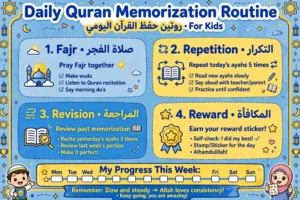
That’s it. Listen, echo, look, recite, share. Five steps. Every day.
Revision Matters More Than New Memorizing
I’ll be straight with you. This is the part nobody wants to hear.
A child can memorize beautifully and still lose it all. Memory fades. It’s how brains work. The fix isn’t more new material. It’s revision.
Most hifz teachers use a three-part daily structure, and it works just as well at home:
- New lesson: the fresh verses learned today.
- Recent revision: what your child learned in the last week or two.
- Old revision: everything memorized before that, rotated through over days.
At home, a simple version looks like this:
- Spend about half your session on revision.
- Only add a new line once the last one feels solid.
- Pick one day a week to review everything your child knows so far, start to finish.
If you’re ever torn between adding something new and reviewing something old, review. Always. A smaller amount that stays is worth far more than a big amount that evaporates.
And here’s a tip that helps a lot: have your child recite memorized surahs in prayer. Salah is the best revision tool there is. A surah recited five times a day doesn’t leave easily.
Make It Feel Good (Seriously)
This is where the emotional part comes in. Because it matters.
A child who feels pressure around the Quran can start to feel dread around the Quran. That’s the last thing any of us want. We want love. So build joy into the routine.
Celebrate small wins. A finished surah deserves a real moment. A favorite dinner. A trip to the park. Telling grandparents on a video call. Pick whatever makes your child light up.
Use a visible tracker. A simple chart on the wall where your child colors in each surah they finish. Kids love seeing progress. It makes the invisible visible.
Add meaning. Tell the story behind the surah in a few sentences. Why was it revealed? What does it teach? A child who understands even a little remembers more, and cares more. If you want to go further, our guide to Quran Arabic for kids explains how learning the language of the Quran makes memorization feel less like sounds and more like understanding.
Let them hear you. Recite in front of your child, even imperfectly. Let them see that the Quran is part of your life too. Kids copy what we do, not what we say.
Skip the comparisons. Never say “Your cousin already finished Juz Amma.” It crushes kids. Every child moves at their own speed.
You might also remind your child, gently, that the Prophet ﷺ said the best among us are those who learn the Quran and teach it. Kids can feel the honor in that.
What to Expect at Different Ages
Every child is different, so treat this as a rough map, not a rulebook.
Ages 4–6. Think listening and playing. Short surahs by ear, with lots of repetition and songs. Sessions of 5–10 minutes. Don’t worry yet about reading from the page.
Ages 7–9. This is often the sweet spot. Kids can read, concentrate a little longer, and love the feeling of achievement. A steady 15–20 minutes works well. Introduce basic tajweed here.
Ages 10–13. Longer attention spans, but also more distractions and, sometimes, more resistance. Give them some choice, like which surah comes next, or when they’d like to practice. Ownership helps a lot.
Teens. Keep it respectful and low-pressure. They respond to purpose and trust, not nagging. Often they want to understand why, so meaning becomes more important than ever.
If your child is older and just starting, don’t panic. It’s never too late. Start small and the habit will build.
Mistakes I See Parents Make

Nobody’s perfect. These are the common ones, and every one of them is fixable.
Going too fast. Parents get excited. They add three lines a day. Two weeks later, everything’s shaky. Slow is faster.
Skipping revision. Covered it above, but it’s the number one reason kids forget.
Correcting every tiny mistake in the moment. Constant interruption kills confidence. Let your child finish the verse, then fix the biggest issue. One or two corrections per session is plenty.
Using the Quran as punishment or a bargaining chip. “No tablet until you finish your hifz.” It backfires. The Quran should never feel like a chore you’re forced into.
Letting long gaps happen. Travel, illness, exams. Life happens. But a two-week gap makes restarting harder. Even five minutes of revision on a bad day keeps the thread alive.
Never getting a teacher involved. More on that next.
When It’s Time to Bring in a Teacher
Here’s the honest truth. Home practice is powerful, but it works best alongside a qualified teacher.
A teacher can hear tajweed mistakes you’d miss. They can set a realistic pace. They bring accountability. A child often behaves differently with a teacher than with a parent. Less arguing, more focus. And you get to go back to being mom or dad, not the Quran police.
That’s exactly how we work at Arabic for Kids. Our Quran & Tajweed course is one-on-one and online. Your child recites, the teacher corrects gently, and you support the routine at home. Home plus teacher is the combination that tends to work best.
Not sure where your child is right now? That’s fine. A free trial lesson is a low-pressure way to find out.
Book a free trial lesson and see how your child responds.
Curious about the bigger picture of Arabic for your child? Our complete parent guide to learning Arabic for kids covers it step by step.
Quick Answers to Common Questions
How much Quran should a child memorize per day? Start with one line or one short verse. Honestly, that’s enough at the beginning. Once the routine feels easy, you can increase gradually. Quality and revision matter more than quantity.
What’s the best age to start? Many children begin listening and learning short surahs from around four or five. Formal memorization often goes more smoothly once a child can read, usually around seven. But there’s no strict cutoff. Start where your child is.
My child keeps forgetting. What should I do? Increase revision, slow down new material, and have your child use memorized surahs in prayer. Forgetting is normal. It doesn’t mean something’s wrong with your child.
Can I do this if I don’t speak Arabic? Yes. Use good recordings, follow along in the mushaf, and let a teacher check the pronunciation. Your role is the routine and the encouragement. You don’t need to be the expert.
What if my child refuses? Step back and look for the cause. Is it too long? Too stressful? Too many corrections? Shorten the session, add something fun, and rebuild the habit gently. A reluctant child usually needs less pressure, not more.
Final Thoughts
Helping your child memorize Quran isn’t a sprint. It’s a slow, quiet habit built one small line at a time.
Pick a short surah. Set a fixed time. Listen, echo, recite, revise. Celebrate every small step. And keep the whole thing warm.
Some days will go well. Some days your child will forget what they knew yesterday. That’s okay. That’s part of it. What your child will remember years from now isn’t the perfect session. It’s that you sat next to them, every day, and showed them the Quran mattered.
That’s the real gift. May Allah make it easy for you and your family.